|
Historical Novels of the Angevins and their Time:Henry II, Eleanor of Aquitaine, Richard the Lionheart, King John (& Henry III)
Novels about King Henry II and Eleanor of Aquitaine and their court Notable events on the European Continent during this period included the Italian merchant Marco Polo's expedition to China. The Crusades, which obsessed Europe from the end of the eleventh century, before Henry's reign, through the thirteenth century, are covered in a separate Crusades section. There is considerable overlap. For example, King Richard the Lionheart was an enthusiastic Crusader, and novels in which he appears primarily in a Crusades setting are located in that section.
Novels about King Henry II and Eleanor of Aquitaine and their Court
The marriage between Henry of Anjou and Eleanor of Aquitaine, said by some to have been a love match, united his possessions of Normandy and Anjou, as well as his claim to the throne of England, with her realms in Aquitaine and Gascony, creating a kingdom that stretched across the Channel. Eleanor and Henry's amity did not persist. The two even warred against each other in 1173 when Eleanor joined the revolt of their eldest son, Henry, who died of dysentery during the revolt. The reign of Henry II was marked by power struggles with the Catholic Church, which came to a head when a group of noblemen murdered Thomas Becket, the Archbishop of Canterbury, in 1170.
Margaret Butler, The Lion of Justice (1975), about the friendship of King Henry II and Thomas Becket; #2 in the Lion trilogy. Margaret Butler, The Lion of Christ (1977), about Thomas Becket; #3 in the Lion trilogy.
Elizabeth Chadwick, The Scarlet Lion (2006), about William Marshal during the reigns of King Richard the Lionheart and King John; #2 in the William Marshal series. Review or Author Interview Elizabeth Chadwick, A Place Beyond Courage (2007), about William Marshal's father, John FitzGilbert Marshal; #3 in the William Marshal series (prequel to The Greatest Knight). Elizabeth Chadwick, To Defy a King (2010), about Mahelt Marshal, who must marry Hugh Bigod after her father, William Marshal, loses favor with King John, and later faces the prospect of disaster when her husband's family also loses the king's favor; #4 in the William Marshal series. Review Elizabeth Chadwick, Templar Silks (2018), about William Marshal's pilgrimage to Jerusalem; #5 in the William Marshal series. Review Elizabeth Chadwick, The Summer Queen (2013), about Eleanor of Aquitaine during her marriage to the French king Louis VII; #1 in the Eleanor of Aquitaine trilogy. Elizabeth Chadwick, The Winter Crown (2014), about Eleanor of Aquitaine after she is crowned Queen of England; #2 in the Eleanor of Aquitaine trilogy. Elizabeth Chadwick, The Autumn Throne (2016), about Eleanor of Aquitaine after the death of Henry II, as she struggles to keep the peace among her sons and to provide well for her daughters; #3 in the Eleanor of Aquitaine trilogy.
Juliet Dymoke, The Royal Griffin (1978), about Eleanor, the daughter of King John and sister of King Henry III, and her marriage to Simon of Montfort; #2 in the Plantagenets series. Juliet Dymoke, The Lion of Mortimer (1979), about King Edward II, his relationship with Piers Gaveston, and his conflicts with the English barons; #3 in the Plantagenets series. Juliet Dymoke, Lady of the Garter (1979), about Princess Joan, the Fair Maid of Kent, and her marriage to the Black Prince; #4 in the Plantagenets series. Juliet Dymoke, The Lord of Greenwich (1980), about King Henry V and his brother Duke Humfrey of Gloucester; #5 in the Plantagenets series. Juliet Dymoke, The Sun in Splendour (1980), about Edward IV, Richard III and the Wars of the Roses; #6 and last in the Plantagenets series.
Christy English, To Be Queen (2011), about Eleanor of Aquitaine and her marriage to Louis VII of France; #2 in the Eleanor of Aquitaine series. Review
Roberta Gellis, Alinor (1978), about a young widow vulnerable to King John's grudge against her, who reluctantly agrees to a marriage of convenience with a man who can protect her; #2 in the Roselynde Chronicles. Roberta Gellis, Joanna (1978), about an heiress afraid of her passion for a man amidst the intrigues of King John's court; #3 in the Roselynde Chronicles. Roberta Gellis, Gilliane (1979), about a beautiful woman who, after being forced into marriage with a man she hates, falls in love with her husband's enemy; #4 in the Roselynde Chronicles. Roberta Gellis, Rhiannon (1982), about a Welsh prince's daughter and her passionate love for a young nobleman at Henry III's court; #5 in the Roselynde Chronicles. Roberta Gellis, Sybelle (1983), about a woman whose love affair is disrupted by a rebellion against the king; #6 in the Roselynde Chronicles. Roberta Gellis, Desiree (2005), about a woman happy in her platonic marriage to a man old enough to be her grandfather until he falls ill and she meets the man sent to protect her as war with France looms; #7 in the Roselynde Chronicles.
Cecelia Holland, The Secret Eleanor (2010), about Eleanor of Aquitaine's efforts to win a divorce from Louis VII of France so she can marry Henry of Anjou, the future Henry II of England. Review Pamela Kaufman, The Book of Eleanor: A Novel of Eleanor of Aquitaine (2002), about the medieval queen who married King Henry II of England. Norah Lofts, Eleanor the Queen (1955; originally published as Queen in Waiting (1968), about Eleanor of Aquitaine. Diana Norman, The King of the Last Days (1981), about a young monk and his risky mission to bring a sword, believed to be King Arthur's Excalibur, to King Henry II in France. Anne O’Brien, Queen Defiant (2011), about Eleanor of Aquitaine during her marriage to Louis VII of France when she goes on Crusade and later meets Henry d'Anjou, the future Henry II of England.
Sharon Kay Penman, The Devil's Brood (2008), about the sons of Henry II and Eleanor of Aquitaine; #3 in the Eleanor of Aquitaine series. Sharon Kay Penman, Lionheart (2011), about Richard the Lionheart; #4 in the Eleanor of Aquitaine series. Sharon Kay Penman, A King’s Ransom (2014), about Richard the Lionheart's last years; sequel to Lionheart.
Mary Pershall, Dawn of the White Rose (1985), historical romance about the medieval knight William Marshal and his wife Isabel de Clare; #2 in the Roses series. Mary Pershall, A Triumph of Roses (1986), historical romance about the son of William Marshal and his wife Eleanor, daughter of King John and sister of King Henry III; #3 in the Roses series. Mary Pershall, Roses of Glory (1987), historical romance about the fictional son of William fitzWilliam Marshal and Eleanor Plantagenet; #4 in the Roses series.
Jean Plaidy, The Revolt of the Eaglets (1977), about Eleanor of Aquitaine; #2 in the Plantagenet series. Jean Plaidy, The Courts of Love (1987), a stand-alone novel about Eleanor of Aquitaine.
Alan Savage, Queen of Love (1995), historical romance which imagines a sexually voracious Eleanor of Aquitaine during her marriage to Henry II; sequel to Savage's Eleanor of Aquitaine (please do not order this book before reading Misfit's Amazon review). A. Schwartz-Bart, The Last of the Just (2000), about eight centuries of persecution of the Jewish people, from an 1185 massacre of Jews in York, England, to the rise of Hitler in Germany; awarded the Prix Goncourt in France. Philippa Wiat, Fair Rosamund (1985), about the mistress of Henry II. Alison Weir, Captive Queen (2010), about Eleanor of Aquitaine and her marriage to Henry II of England.
Kings Richard and John, Their Queens and Courts
Henry and Eleanor's sons were as fractious as their parents. Richard, known as "the Lionheart" is best known for his energetic leadership during the Crusades (novels centering on the Crusades appear in the separate Crusades section). Even after succeeding his father as king, Richard spent most of his time at war trying to recapture Jerusalem from Muslim control. His mother, Queen Eleanor, ruled as regent in his absence. When he died, his brother John (who had tried to usurp the throne while Richard was on crusade) succeeded him. John was unpopular. His nobles forced him to sign the Magna Carta, which reduced the king's power.
Rachel Bard, Queen Without a Country (2000), about Berengaria, the wife of Richard the Lionheart. Rachel Bard, Isabella: Queen Without a Conscience (2006), about the beautiful and ambitious Isabella of Angoulême, the wife of King John of England.
Angus Donald, Holy Warrior (2011), about Robin Hood and his men with the army of Richard I in the Crusades; #2 in the Outlaw Chronicles series. Angus Donald, King's Man (2012), about Robin Hood and his men as they search for King Richard I, taken captive during his return from the Crusades; #3 in the Outlaw Chronicles series. Angus Donald, Warlord (2012), about Robin Hood and his men during the last years of Richard I after his return from captivity following the Crusades; #4 in the Outlaw Chronicles series. Angus Donald, Grail Knight (2013), about Robin Hood and his men competing with a group of Templars to find the Holy Grail; #5 in the Outlaw Chronicles series. Angus Donald, The Iron Castle (2014), about Robin Hood and his men fighting in King John's army in France; #6 in the Outlaw Chronicles series. Angus Donald, The Death of Robin Hood (2016), about Robin Hood and his men; #7 and last in the Outlaw Chronicles series.
Molly Costain Haycraft, My Lord Brother the Lion Heart (1968), about Joan of England, the daughter of Henry II and Eleanor of Aquitaine, beginning with the death of her first husband, King William II of Sicily. Lisa Hilton, The Stolen Queen (2016), about Isabelle of Angoulême, who was betrothed to Hugh de Lusignan, a follower of the ‘old religion,’ before she was married to King John. Tom Holt, Overtime (1993), about a World War II pilot who slips back in time and becomes involved in the search for the captive Richard the Lionheart. Norah Lofts, The Lute Player (1951), about Berengaria, who became Richard the Lionheart's wife, and Blondel, a minstrel who accompanied Richard to the Crusades. Review Jean Plaidy, The Heart of the Lion (1977), about Richard the Lionheart; #3 in the Plantagenet series. Jean Plaidy, The Prince of Darkness (1978), about King John; #4 in the Plantagenet series. Jean Plaidy, The Battle of the Queens (1978), about the Dowager Queens of England and France: Isabella, the widow of King John of England, and Blanche, the widow of Louis VIII of France; #5 in the Plantagenet series. Martha Rofheart, The Lionheart (1981), about Richard the Lionheart. Gore Vidal, A Search for the King (1950), about the minstrel Blondel's search for Richard the Lionheart after the latter is captured and imprisoned by a rival while returning from the Crusades.
England in the Reigns of Henry II, Richard, John and Henry III
After the thirteen long years of warfare between Stephen and Matilda, the reign of Henry II came as a welcome interval of peace for England, in which cathedrals were built, laws stabilized, and simmering resentments between Saxons and Normans gradually gave way to a common purpose in the distant Crusades, though the Jews of Europe found new cause for fear. Many novels are set during this period, which offers a classic "High Middle Ages" atmosphere. John's eldest son succeeded him as Henry III. The reign of Henry III, who came to the throne as a child, was marked by warfare against Wales. Few historical novels center on Henry III, but he is an important antagonist in Sharon Kay Penman's Falls the Shadow and Edith Pargeter's Brothers of Gwynedd series, set in Wales during his reign. See the Medieval Celts section for these.
Elizabeth Ashworth, The de Lacy Inheritance (2010), about a returning Crusader with leprosy whose young sister will be forced to marry an elderly landowner unless he can stop the marriage. Ann Baer, Down the Common: A Year in the Life of a Medieval Woman Gary L. Blackwood, The Lion and the Unicorn Robyn Cadwallader, The Anchoress (2015), about a young woman who becomes a a religious recluse in thirteenth-century England. Review. Marsha Canham, Through a Dark Mist Marsha Canham, In the Shadow of Midnight Marsha Canham, The Last Arrow Diane Carey, Under the Wild Moon Ruth A. Casie, The Guardian's Witch Elizabeth Chadwick, The Champion (1997), about a young Norman knight and the woman he betrays. Elizabeth Chadwick, Shields of Pride (1994), about a mercenary soldier's love for a beautiful young noblewoman during the wars between King Henry II and his rebellious sons. Elizabeth Chadwick, The Marsh King's Daughter (1999), about an injured soldier and the woman who nurses him back to health during the time of King John. Elizabeth Chadwick, The Outlaw Knight (2000, also titled Lords of the White Castle), about a feud between two families over an estate in the Welsh borderlands during the time of King John.
Thomas B. Costain, Below the Salt Thomas B. Costain, The Black Rose Katherine Deauxville, Daggers of Gold (1993), historical romance about a recently returned Crusader responsible for delivering a Saxon bride to Prince Henry in Norman England. Katherine Deauxville, The Amethyst Crown Katherine Deauxville, The Crystal Heart (1995), historical romance about a young wife who takes desperate measures to conceive an heir for her aged husband. Kathrynn Dennis, Dark Rider (2007), historical fantasy/romance about a woman in thirteenth century England with an uncanny ability to understand and heal horses. Kathrynn Dennis, Awakening His Lady (2009), spicy historical romance set in the time of King John about a knight sent to war in France after spending a single passionate night with the lady he loves; available in ebook form only. Alfred Duggan, Leopards and Lilies (1954), about a noblewoman in the time of King John. Kat Duncan, A Lady of Worth Kat Duncan, Without a Lord Barbara Erskine, Lady of Hay (1986), about a modern woman who under hypnotic past-life regression, remembers a life as Matilda de Braose in the medieval England of King John's time. Review Gayle Feyrer, The Thief's Mistress David Flusfeder, John the Pupil (2015), about a young man who has studied at a Franciscan monastery under Roger Bacon and is sent to Rome in 1267 on a secret journey to deliver Bacon's mathematical and scientific work "Opus Majus," to the pope. Ken Follett, Pillars of the Earth (1989), about the building of a cathedral in twelfth century England. Review Katia Fox, The Copper Sign (2006 in the original German, 2011 in English), about a blacksmith's daughter who wants to become a swordsmith and travels to Normandy disguised as a boy to learn the trade; #1 in a trilogy. Nicole Galland, Godiva (2013), about Lady Godiva and her legendary ride, naked on horseback, to relieve her husband's peasantry of an oppressive tax burden. Harry E. Gilleland, Jr., A Wandering Warrior Noah Gordon, The Physician (1986), an eleventh century Englishman studies medicine in Persia; #1 in the Cole Trilogy (#2, Shaman, is set during the U.S. Civil War; #3, Matters of Choice, is contemporary). Feona J. Hamilton, Belaset's Daughter Feona J. Hamilton, After Evesham Wilson Harp, The Ghost of Sherwood Virginia Henley, The Falcon and the Flower (1989), historical romance set in the time of King Richard the Lionheart. Domini Highsmith, Keeper at the Shrine Domini Highsmith, Guardian at the Gate Domini Highsmith, Master of the Keys Helen Humphreys, The Frozen Thames (2009), a collection of brief short stories about the forty times when the River Thames froze from 1142 to 1895. Review Grace Ingram, Red Adam's Lady Lauren Johnson, The Arrow of Sherwood Kathryn Kramer, Lady Outlaw Karen Maitland, The Raven’s Head (2015), about an apprentice librarian in thirteenth-century England who must flee after stumbling upon a dangerous secret. Renee Masson, Tearing Honor Diana Norman, Fitzempress' Law Edith Pargeter, The Heaven Tree (1960), about a power-struggle between two men as one builds a cathedral for the other in thirteenth century England near the border with Wales; #1 in the Heaven Tree trilogy. Edith Pargeter, The Green Branch (1962), about a young man in the thirteenth century Welsh court of Llywelyn who sets out to avenge his father's death; #2 in the Heaven Tree trilogy. Edith Pargeter, The Scarlet Seed (1963), about a young man with divided loyalties during the wars between England and Wales; #3 in the Heaven Tree trilogy. Edith Pargeter, The Marriage of Meggotta (1979), about the secret marriage between ten-year-old Meggotta, the daughter of the Earl of Kent, and the Earl's ward, the orphaned Richard de Clare, and its tragic consequences. Anne Rice, Angel Time (2009), about a present-day killer given the chance to redeem his soul by going back in time to thirteenth-century England to protect an innocent Jewish couple accused of murdering their daughter. Review Patricia Ryan, Silken Threads Sir Walter Scott, The Betrothed (1825), a love story set in the violent Welsh borderlands during the reign of Henry II. Reay Tannahill, Having the Builders In Reay Tannahill, Having the Decorators In Adam Thorpe, Hodd (2009), a realistic imagining of what the outlaw whose story developed into the Robin Hood legend might really have been like, based on the earliest ballad sources. Review Catherine J. Todd, Marian Lindsay Townsend, A Knight's Enchantment (2010), historical romance about a woman alchemist working to free her father from imprisonment by a corrupt bishop, and a knight who shares her hatred of the bishop. Elsa Watson, Maid Marian, about the woman in the life of the legendary outlaw Robin Hood. Hebe Weenolsen, To Keep This Oath Sharon Whitby, The Last of the Greenwood Jay Williams, The Good Yeomen Alicia A. Willis, To Birmingham Castle Alicia A. Willis, In Search of Adventure Marco Polo
At the age of seventeen, Marco Polo set out on a journey along the Silk Road with his merchant father and uncle on a diplomatic mission for the pope to the imperial court of Kublai Khan in China. There they remained for the next seventeen years. Marco became a valued official of the Khan. After the Polos returned to Europe and settled in Venice, Marco wrote a book about his travels, which has inspired several novels.
Gary Jennings, The Journeyer Richard Llewellyn, Warden of the Smoke and Bells (1956), set in Italy during the time of Marco Polo Edison Marshall, Caravan to Xanadu Mysteries Set in Britain
Click on the title for more information from Powell's Books or another online source, or if you're outside the U.S., try The Book Depository.
Alys Clare, Ashes of the Elements (2000), about an abbess and a former soldier who investigate the violent death of the woodsman who felled a grove of oaks; #2 in the Hawkenlye mystery series. Alys Clare, The Tavern in the Morning (2000), about an abbess and a former soldier who investigate the death by poisoning of a guest staying at an inn; #3 in the Hawkenlye mystery series. Alys Clare, The Chatter of the Maidens (2001), about an abbess who must find a missing nun while her friend and fellow sleuth lies near death from blood poisoning; #4 in the Hawkenlye mystery series. Alys Clare, The Faithful Dead Alys Clare, A Dark Night Hidden Alys Clare, Whiter Than the Lily (2004), about an abbess and a former soldier who investigate the poisoning death of a beautiful young wife who came to the abbey to use its healing waters; #7 in the Hawkenlye mystery series. Alys Clare, Girl in a Red Tunic (2005), about an abbess and a former soldier who must investigate a murder that occurs after her long-lost son returns to her seeking help; #8 in the Hawkenlye mystery series. Alys Clare, Heart of Ice (2006), about an abbess and a former soldier who investigate the death of a man whose corpse is found in an icy lake; #9 in the Hawkenlye mystery series. Alys Clare, The Enchanter's Forest (2007), about an abbess and a former soldier who investigate the murder of a man who made enemies after claiming to have found Merlin's tomb; #10 in the Hawkenlye mystery series. Alys Clare, The Paths of the Air Alys Clare, The Joys of My Life Alys Claire, The Rose of the World (2011), about a former abbess whose granddaughter disappears in 1210 during the time when King John is excommunicate; #13 in the Hawkenlye mystery series.
Ariana Franklin, The Serpent's Tale (2008; titled The Death Maze in the U.K.), King Henry II, suspecting Queen Eleanor of using poison to murder his mistress, summons the Mistress of the Art of Death out of retirement to determine the truth; #2 in the Adelia Aguilar mystery series; Ariana Franklin is a pen name of Diana Norman. Ariana Franklin, Grave Goods (2009), about a woman doctor from Salerno, Italy, called upon by King Henry II in the hope she can prove the bones recently uncovered at Glastonbury Abbey are those of King Arthur and Queen Guinevere; #3 in the Mistress of the Art of Death series. Review Ariana Franklin, A Murderous Procession (2010; also titled The Assassin's Prayer), about a woman physician who accompanies King Henry II's daughter, ten-year-old Joanna, on the trip to her bridegroom in Sicily, and must protect her from assassins on the way; #4 in the Mistress of the Art of Death series. Review
Sarah Hawkswood, Servant of Death (2015; also titled The Lord Bishop's Clerk), about a Worcester thief-taker and the undersheriff who is his new boss who must work together to find out who murdered the Bishop of Winchester's widely feared and hated clerk; #1 in the Bradecote and Catchpoll mystery series. Sarah Hawkswood, Ordeal By Fire (2016), about a Worcester thief-taker and his boss, the undersheriff, who must find a murderous arsonist; #2 in the Bradecote and Catchpoll mystery series.
Judith Koll Healey, The Rebel Princess (2009), about a French princess who enlists the aid of a group of Cathar women to rescue her illegitimate son; #2 in the Alais Capet mystery series.
Bernard Knight, The Poisoned Chalice (1998), about a crowner (the old name for a coroner) in twelfth century Devon who suspects there are connections between a case of rape and a woman's death following an illegal abortion; #2 in the Crowner John mystery series. Bernard Knight, Crowner's Quest (1999), about a crowner (the old name for a coroner) in twelfth century Devon whose investigation into the apparent suicide of a canon is hampered by a corrupt sheriff; #3 in the Crowner John mystery series. Bernard Knight, The Awful Secret (2000), about a crowner (the old name for a coroner) in twelfth century Devon whose life is complicated when an old acquaintance from his years as a Crusader reappears claiming to be in possession of an awful secret; #4 in the Crowner John mystery series. Bernard Knight, The Tinner's Corpse (2001), about a crowner (the old name for a coroner) in twelfth century Devon and his investigation into the death of tin miner in the moors, where the Saxon miners resent his interference; #5 in the Crowner John mystery series. Bernard Knight, The Grim Reaper (2002), about a crowner (the old name for a coroner) in twelfth century Devon investigating a series of murders he deduces must have been committed by a priest; #6 in the Crowner John mystery series. Bernard Knight, Fear in the Forest (2003), about a crowner (the old name for a coroner) in twelfth century Devon investigating the murder of a forest officer charged with preventing poaching in the royal forests; #7 in the Crowner John mystery series. Bernard Knight, The Witch Hunter (2004), about a crowner (the old name for a coroner) in twelfth century Exeter who finds he must investigate a case in which a man's death is being attributed to witchcraft; #8 in the Crowner John mystery series. Bernard Knight, Figure of Hate (2005), about a crowner (the old name for a coroner) in twelfth century Devon who investigates a murder following a jousting tournament; #9 in the Crowner John mystery series. Bernard Knight, The Elixir of Death (2006), about a crowner (the old name for a coroner) in twelfth century Devon investigating the wreck of a ship and slaughter of its crew while Prince John plots to displace his brother, Richard the Lionheart, from the throne of England; #10 in the Crowner John mystery series. Bernard Knight, The Noble Outlaw (2007), about a crowner (the old name for a coroner) in twelfth century Devon and his conflict with a corrupt sheriff over who murdered the treasurer of a local guild; #11 in the Crowner John mystery series. Bernard Knight, The Manor of Death (2008), about a crowner (the old name for a coroner) in twelfth century Devon whose murder investigation in the harbor town of Axmouth is put at risk by a conspiracy of silence among the populace; #12 in the Crowner John mystery series. Bernard Knight, Crowner Royal (2009), about a crowner (the old name for a coroner) newly appointed to an important position in Westminster who suspects that a recent murder may be part of a plot to overthrow King Richard; #13 in the Crowner John mystery series. Bernard Knight, A Plague of Heretics (forthcoming in Sept. 2010), about a crowner (the old name for a coroner) accused of being too sympathetic to a group of heretics the public suspects of being behind an outbreak of murders in Exeter; #14 in the Crowner John mystery series.
Ian Morson, Falconer's Judgement Ian Morson, Falconer and the Face of God (1996), about a professor at Oxford who witnesses a death during a performance of street players and sets out to investigate it; set during the reign of Henry III; #3 in the Medieval Oxford Mystery series. Ian Morson, A Psalm for Falconer (1997), about a professor at Oxford who sees a body being uncovered from the sands at Lancaster Bay and wonders whether it was a case of murder; set during the reign of Henry III; #4 in the Medieval Oxford Mystery series. Ian Morson, Falconer and the Great Beast Ian Morson, Falconer and the Moving Sands Ian Morson, Falconer and the Ritual of Death
Sharon Kay Penman, Cruel as the Grave (1998), about a knight in the service of Queen Eleanor of Aquitaine charged with investigating not only political schemes but a murder in a churchyard; #2 in the Justin de Quincey medieval mystery series. Sharon Kay Penman, Dragon's Lair (2003), about a knight in the service of Queen Eleanor of Aquitaine, who is sent to Wales to track down a missing ransom payment intended to help free Richard the Lionheart; #3 in the Justin de Quincey medieval mystery series. Sharon Kay Penman, Prince of Darkness (2005), about a knight in the service of Queen Eleanor of Aquitaine, who investigates a forged document implicating Prince John in a plot to kill his brother, King Richard the Lionheart; #4 in the Justin de Quincey medieval mystery series.
Priscilla Royal, Tyrant of the Mind (2005), about a young prioress during the reign of Henry III who tries to prove her brother is innocent of murder after he is discovered standing over the corpse with a bloody knife in his hand; #2 in the Eleanor of Tyndal mystery series. Priscilla Royal, Sorrow Without End (2006), about a young prioress during the reign of Henry III who helps in tracking down a vicious serial killer; #3 in the Eleanor of Tyndal mystery series. Priscilla Royal, Justice for the Damned (2007), about a young prioress during the reign of Henry III who is confronted with a case of murder when she investigates a suspected ghostly apparition; #4 in the Eleanor of Tyndal mystery series. Priscilla Royal, Forsaken Soul (2008), about a young prioress during the reign of Henry III who investigates a series of poisoning deaths; #5 in the Eleanor of Tyndal mystery series. Priscilla Royal, Chambers of Death (2009), about a prioress who takes shelter with a group of her nuns in a manor house where a murder occurs; #6 in the Eleanor of Tyndal mystery series. Priscilla Royal, Valley of Dry Bones (2010), about a prioress who must find out who murdered one of the queen's emissaries before the queen's anticipated visit to her priory; #7 in the Eleanor of Tyndal mystery series. Priscilla Royal, A Killing Season (2011), about a prioress who investigates the case of a Crusader whose sons have been dying in mysterious accidents, leading people to wonder whether he has been cursed for his sins; #8 in the Eleanor of Tyndal mystery series. Priscilla Royal, Covenant with Hell (2013), about a prioress who investigates the case of a nun who falls to her death from a bell tower; #9 in the Eleanor of Tyndal mystery series.
12th and 13th Century European Continent
Most of the novels about twelfth and thirteenth century Europeans from the Continent are about the Crusades and appear on the Crusades page. These centuries saw many interesting events on European soil, though, from the rise of the troubadours to a Mongol invasion. Some of the most interesting personalities of the period were people with religious vocations, such as Hildegard of Bingen (see article) and the lovers Heloise and Abelard. Jump to: Mysteries: 12th and 13th Century European Continent
Antoine Audouard, Farewell, My Only One Margaret Ball, A Bridge to the Sky Michelle Cameron, The Fruit of Her Hands: The Story of Shira of Ashkenaz (2009), about the wife of the Jewish scholar Meir ben Baruch of Rothenberg and the struggle of her and her husband to find safety in Paris and then Germany amid the anti-Semitism raging through Europe in the thirteenth century. Dana Chamblee Carpenter, Bohemian Gospel (2016), about a girl with supernatural powers in thirteenth-century Bohemia whose healing ability saves the young King Ottakar from an assassin's arrow. Review Meg Clothier, The Girl King (2011), about Tamar, the daughter of King Giorgi of Georgia, chosen by her father as his heir, but facing opposition from the Georgian nobles amid the threat of war. Review at The Independent Meg Clothier, The Empress (2013), about Princess Agnes of France, who in 1179 at age thirteen marries the heir to the Byzantine throne. James Cowan, A Troubadour's Testament (1998), about a writer who discovers a manuscript by the twelfth century troubadour Marcabru celebrating his love for a Cathar nun, and sets out on a journey in Marcabru's footsteps. Martin Davies, The Unicorn Road (2009), about a thirteenth century expedition sent by King Manfred of Sicily to China to bring back exotic animals as a gift for the pope. Review Umberto Eco, Baudolino (2002), a literary novel set in twelfth century Italy. Lion Feuchtwanger, Raquel: The Jewess of Toledo Nicole Galland, The Revenge of the Rose (2007), about a poor Burgundian knight and a minstrel in the court of the Holy Roman Emperor around the year 1200. Cecelia Holland, Until the Sun Falls Sherry Jones, Four Sisters, All Queens (2012), about four sisters in thirteenth-century Provence who each become queens through marriage. Sherry Jones, The Sharp Hook of Love (2014), about Heloise and Abelard. Review Barbara Lachman, Hildegard, the Last Year (1993; originally titled The Journal of Hildegard of Bingen: A Novel), about the final year of Hildegard of Bingen's life, when Hildegard and her community of nuns were forbidden to celebrate the Divine Office as punishment for burying in holy ground a man who was believed to have been excommunicated. Jeanne Lancour, The Storm and the Sword Marion Meade, Stealing Heaven (1979), about the twelfth-century French lovers Heloise and Abelard. Joyce Elson Moore, The Tapestry Shop (2010), about the French trouvere Adam de la Halle, who set down the first written version of the Robin Hood story. Mary O’Connell, The King’s Daughter: Hildegard of Bingen (2003), a biographical novel about the twelfth century nun who wrote books and songs, founded her own convent, and scolded popes and emperors; hard to find outside Australasia. Joan Ohanneson, Scarlet Music: Hildegard of Bingen, a Novel (1997), a biographical novel about Hildegard of Bingen. Sophie Perinot, The Sister Queens (2012), about the friendship and rivalry of Marguerite and Eleanor of Provence, one of whom married King Louis IX of France, the other King Henry III of England. Bernard Reilly, Journey to Compostela: A Novel of Pilgrimage and Peril Luise Rinser, Abelard's Love (1998), about Astralabe, the son of the medieval French theologian Abelard and his student Heloise, and his quest to understand his parents' unusual relationship. Mary Sharratt, Illuminations (2012), about the twelfth-century German mystic Hildegard of Bingen. Review or Author Interview William Watson, The Knight on the Bridge Tod Wodicka, All Shall Be Well: And All Shall Be Well; and All Manner of Things Shall Be Well (2007), about a fanatical re-enactor from New York who specializes in the early medieval period and travels to Germany for a music festival celebrating Hildegard of Bingen; set entirely in the present day. New York Times Review
Mysteries: 12th and 13th Century European ContinentClick on the title for more information from Powell's Books or another online source, or if you're outside the U.S., try The Book Depository.
Alan Gordon, Jester Leaps In (2000), about a thirteenth century jester and agent for the Fools' Guild sent to Byzantium to investigate the disappearance of six agents; #2 in the Fools' Guild mystery series. Alan Gordon, A Death in the Venetian Quarter (2002), about a jester and agent for the Fools' Guild who must solve a seemingly minor case of murder that may hold the key to saving Constantinople from a besieging army of Crusaders in 1203; #3 in the Fools' Guild mystery series. Alan Gordon, The Widow of Jerusalem Alan Gordon, An Antic Disposition (2004), about a thirteenth century jester and agent for the Fools' Guild who realizes he knows the ending to a story told by their leader while the Guild is in hiding from the Pope's army; #5 in the Fools' Guild mystery series. Alan Gordon, The Lark's Lament (2007), about a jester and agent for the Fools' Guild who must solve a murder that occurs in 1204 while he is seeking an abbot's help in interceding with the Pope; #6 in the Fools' Guild mystery series. Alan Gordon, The Moneylender of Toulouse (2008), about a jester and agent for the Fools' Guild who must find out who murdered the moneylender of Toulouse in 1204; #7 in the Fools' Guild mystery series. Alan Gordon, The Parisian Prodigal (2010), about a husband-wife team of jesters who must find out the truth when a man appears claiming to be the long-lost brother of the Count of Toulouse and a prostitute is murdered; #8 in the Fools' Guild mystery series. Review or Author Interview
Sharan Newman, The Devil's Door (1994), a novice in a twelfth century French convent tries to solve a mystery; #2 in the Catherine LeVendeur mystery series. Sharan Newman, The Wandering Arm (1995), a former novice nun and her husband solve mysteries in twelfth century France; #3 in the Catherine LeVendeur mystery series. Sharan Newman, Strong as Death (1996), a former novice nun and her husband solve mysteries in twelfth century France; #4 in the Catherine LeVendeur mystery series. Sharan Newman, Cursed in the Blood (1998), a former novice nun and her husband travel from France to Scotland to find out who is murdering members of his family; #5 in the Catherine LeVendeur mystery series. Sharan Newman, The Difficult Saint (1999), a former novice nun and her husband solve mysteries in twelfth century France; #6 in the Catherine LeVendeur mystery series. Sharan Newman, To Wear the White Cloak (2000), a former novice nun and her husband solve mysteries in twelfth century France; #7 in the Catherine LeVendeur mystery series. Sharan Newman, Heresy (2002), a former novice nun and her husband solve mysteries in twelfth century France; #8 in the Catherine LeVendeur mystery series. Sharan Newman, The Outcast Dove (2003), a Jewish-born Catholic travels from medieval France to Spain to solve a mystery; #9 in the Catherine LeVendeur mystery series. Sharan Newman, The Witch in the Well
Top of Page
|
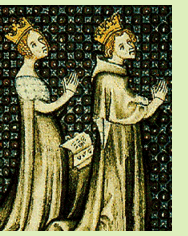 Henry of Anjou, the son of Empress Matilda, claimed the throne of England as Henry II after her rival Stephen I died in 1154, becoming the first Angevin king of England. His queen, Eleanor of Aquitaine, was a formidable royal personage in her own right. This section covers the period beginning with Henry's reign through the reigns of his sons Richard and John and his grandson, John's son Henry III (the first king to use the Plantagenet surname).
 (2012), a novel portraying Robin Hood as a woman; self-published.
 (1997), about a peasant woman in an isolated English village.
  (1982), a nontraditional retelling of the Robin Hood story in which a wandering minstrel falls in love with a woman outlaw.
 (1991), historical romance about a young widow ambushed on her way to her second wedding in the time of King John; #1 in the Robin Hood series.
 (1994), historical romance about a noblewoman who flees to Wales rather than marry the man King John has selected for her; #2 in the Robin Hood series.
 (1997), historical romance about a noblewoman in Norman France who falls in love with a man from England who trespasses on her father's estate; #3 in the Robin Hood series.
 (1986), historical romance based on the Robin Hood legend which centers on the Will Scarlet character.
  (2013), historical romance set in the thirteenth century about a man who enters a bargain to protect a castle on the Scottish border for a year in order to win it as his own estate, and a woman with second sight.
 (1983), a retelling of the Robin Hood story which features Robin (Robert of Locksley) as a knight in the service of King Richard the Lionheart during the Crusades.
 (1957), about the period leading up to the signing of the Magna Carta in thirteenth century England.
  (1945), about an English nobleman's illegitimate son who travels to China in the late thirteenth century.
 (1994), historical romance about a young heiress, wed and widowed three times since she was fourteen, who falls in love for the first time.
 (2011), historical romance about a knight, sworn to protect his lord's lands, and the lady in distress whom he rescues; self-published; #1 in the Cumbria trilogy.
 (2011), historical romance about a knight who sets out to take his lord's lands and lady; self-published; #2 in the Cumbria trilogy.
 (1996), historical romance based on the Robin Hood legend, featuring Marian as a spirited and independent woman.
 (2013), about a soldier who falls in love with a Traveler woman when he goes in search of vengeance for his brother's death.
 (2001), about a Jewess who on the eve of her wedding in 1264 becomes a spy for Henry III.
  (2010), about the Jews of London after the Battle of Evesham in 1265 when King Henry III defeated Simon of Montfort; sequel to Belaset's Daughter.
 (2013), a retelling of the Robin Hood story in which the Sheriff of Nottingham invents a gang of thieves in order to get rich by pocketing taxes due to the king; self-published.
 (2013), about the legendary Robin Hood, a nobleman who returns from the Crusades to find his lands have been stolen and England is in turmoil.
  (1997), historical romance about a noblewoman who joins Robin Hood's band during the time of King John.
 (2011), about the conflicts within a family after they send their daughter to a convent and she begins to use witchcraft; self-published.
 (1999), historical romance about an injured mercenary and the young widow who gives him refuge.
 (1991), a retelling of the Robin Hood story from Marian's perspective.
 (1958), about a twelfth-century surgeon.
 (1975), a novel about a man and woman who are initiated to serve as "the" Robin Hood, a Green Man figure, and his bride Marian.
 (1948), a retelling of the Robin Hood story which centers on the experiences of an escaped serf, "Little John," who joins Robin's band of outlaws.
 (2012), about a young Norman nobleman and his friends who wish to reform chivalry; Christian message; #1 in the Comrades of Honor series; self-published.
 (2012), about a knight and his squire whose trip to visit friends turns into a perilous journey; Christian message; #2 in the Comrades of Honor series; self-published.
 (2002), about an abbess and a former soldier who investigate a mystery with roots that go back before the Second Crusade; #5 in the Hawkenlye mystery series.
 (2003), about an abbess and a former soldier who investigate the murder of a fanatical priest ; #6 in the Hawkenlye mystery series.
 (2008), about an abbess and a former soldier who investigate the connections between a secretive, dark-skinned stranger and a brutalized corpse in the forest; #11 in the Hawkenlye mystery series.
 (2008), about an abbess and a former soldier asked by Queen Eleanor to investigate dark rumors about the past of her recently deceased son, King Richard; #12 in the Hawkenlye mystery series.
 (1999), about a professor at Oxford who investigates murder; #6 in the Medieval Oxford Mystery series.
 (2000 in the original French, 2004 in English), about Heloise and Abelard.
 (1989), about a thirteenth-century architect and his travels in Egypt, France and Hungary.
 (1981), a love story set in Aquitaine during the twelfth century age of the troubadours.
 (1982), about a mad knight and his family in a run-down castle in Provence and the crisis that arises when a murderer stays as a guest in the castle.