Historical Novels: Medieval Normans
The Norman Conquest and England from 1066-1133; 11th-12th Century Sicily
Jump to:
The Norman Conquest
The Reign of William I (most Robin Hood novels are listed here)
The Reign of William Rufus
The Wars between Stephen and Matilda
Norman Italy and Sicily
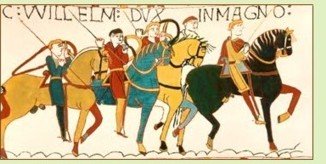 The medieval Normans were Norsemen who originally settled in northern coastal France. William of Normandy became king of England on winning the Battle of Hastings in 1066. A leader in the Saxon uprisings that followed was Hereward, said to have made his base on the Isle of Ely, surrounded by treacherous marshes. Novels about the period leading up to the Conquest and about Harold II, the Saxon king defeated by William the Conqueror, are included in this section.
Saxon resentment of the Norman aristocracy was behind the legend of Robin Hood, a Saxon outlaw said to have stolen from the rich and given to the poor. (Many Robin Hood tales are set during the reigns of Richard the Lionheart and/or King John, so see the Angevins page for those.) Another popular legend was Lady Godiva's nude horseback ride through Coventry to force her husband to remit an oppressive tax. Godiva, or Godgifu, was a real woman, the wife of Leofric, Earl of Mercia, although no documents of her time allude to the legend.
The next king, William Rufus, died in a hunting accident on August 2, 1100. Because August 2 was celebrated as Lughnasa by the pagan Celts, some have speculated he was killed as a pagan sacrifice. His brother Henry succeeded him. Henry's will named his daughter Matilda (or Maud) to succeed him, but his nephew Stephen of Blois claimed the throne, causing a civil war that ended only when the dying Stephen named Matilda's son Henry as his successor. Henry II became the first Plantagenet king.
During the eleventh and twelfth centuries, mercenary soldiers from Normandy migrated to southern Italy and Sicily, gradually displacing the Muslim Saracens who had ruled there during the tenth century. For more information, see the article on Medieval Sicily.
The Norman Conquest
Click on the title for more information from Powell's Books or another online source, or if you're outside the U.S., try The Book Depository.
James Aitcheson, The Harrowing (2016), about five travelers in northern England fleeing the Norman armies on their way to find sanctuary in the last Saxon stronghold.
Valerie Anand, Gildenford (1977), about England in the decades leading up to the Norman Conquest; #1 in the Norman series.
Valerie Anand, The Norman Pretender (1979), about two brothers who fight on opposite sides during the Norman Conquest; #2 in the Norman series.
Valerie Anand, The Disputed Crown (1982), about the Saxon resistance following the Norman Conquest; #3 in the Norman series.
Aileen Armitage, To Catch and Conquer (2001 reissue; originally published 1973 as King Bastard under the name Aileen Quigley), about the William, the Duke of Normandy
Stewart Binns, Conquest (2011), about Hereward, a Saxon leader who resisted the Norman invasion both before and after the Battle of Hastings, #2 in the Interim Kings series. Review
Stewart Binns, Crusade (2012), about Edgar the Atheling and his allies as the Crusades interrupt their planning to overthrow William the Conqueror; #2 in the Interim Kings series.
Laurence J. Brown, Housecarl (2001), about a housecarl, a member of King Harold's personal guard, who fights in the Battle of Hastings; self-published.
Laurence J. Brown, Cold Heart, Cruel Hand: A Novel Of Hereward The Wake And The Fen Rebellion Of 1070-1071 , about one of King Harald's personal guards who joined the Saxon resistance to the Normans led by Hereward the Wake; self-published.
Ray Bryant, Warriors of the Dragon Gold, about the years leading up to the Norman Conquest.
Bryher, The Fourteenth of October (1952), about a Saxon boy in his teens who witnesses the Battle of Hastings. Review
Bryher, This January Tale (1966), about the period following the Battle of Hastings in 1066.
Naomi and Deborah Baltuck, Keeper of the Crystal Spring, historical romance about a young Saxon woman who grew up in the years immediately following the Norman Conquest and plans to dedicate her life to serving the Great Mother Goddess.
Sarah Bower, The Needle in the Blood (2007), about the bishop who commissions the Bayeux Tapestry to commemorate his brother's conquest of England, and a Saxon woman who works on the embroidery. Review
Elizabeth Chadwick, The Conquest (1996), about a woman in the time of the Norman Conquest who must flee to London with her illegitimate child when her lover's wife rejoins him.
Berwick Coates, The Last Conquest (2013), about a young scout in King William's army and a houndsman to King Harold at the Battle of Hastings in 1066; #1 in the Norman Conquest trilogy.
Berwick Coates, The Last Viking (2014), about King Harold of England and the challenges to his rule after the death of Edward the Confessor in 1066; #2 in the Norman Conquest trilogy.
Noel B. Gerson, The Conqueror's Wife (1957), about Matilda of Flanders, who became the wife of William the Conqueror.
Parke Godwin, Lord of Sunset (1998), about Harold, the last Saxon king of England, and his wife Edith.
Georgette Heyer, The Conqueror (1931), a biographical novel about William the Conqueror.
Cecelia Holland, The Firedrake (1966), about the Norman Conquest and the Battle of Hastings. Review
Helen Hollick, Harold the King (2000; titled I Am the Chosen King in the U.S.), about the last Saxon king of England, Harold Godwinesson; sequel to The Forever Queen (titled A Hollow Crown in the U.S. - see the Anglo-Saxons page for the listing, or the review).
G.K. Holloway, 1066: What Fates Impose (2013), about the power struggles of the last twenty years of Anglo-Saxon England and the Battle of Hastings; self-published.
Steven James, Godiva and the Golden Dragon, about the events that follow Lady Godiva's naked ride through the streets of Coventry in the days before the 1066 Norman invasion.
Nerys Jones, Godiva (2008), about the Saxon Lady Godiva of legend, her husband the Earl of Mercia, and the disasters that follow when King Edward the Confessor of England lures their son into committing treason in the years before the Norman Conquest. Review
Charles Kingsley, Hereward, the Last of the English (1866; also titled Hereward the Wake), a novel about a historical Anglo-Saxon who led the resistance to the Norman Conquest after the Battle of Hastings; a novel that exemplifies the Victorian admiration for “muscular Christianity”.
Paul Kingsnorth, The Wake (2015), about a Saxon landowner in the aftermath of the Norman invasion of 1066; written in an updated version of Old English.
Paul Kingsnorth, Beast (2017), about a lone man on a West Country moor who is aware that he is being tracked by a beast of some kind; sequel to The Wake.
Mary Lancaster, An Endless Exile, about the wife of Hereward, who led the English resistance to the Norman Conquest.
Merlin Douglas Larsen, Jackals in Iron (1999), about a nobleman who was an enemy of William of Normandy from boyhood, but joins his war against the King of England for the purpose of vengeance.
Hilda Lewis, Wife to the Bastard (1966), about Matilda, the wife of William the Conqueror.
Mary Lide, Fortune's Knave: The Making of William the Conqueror (1992), about the childhood and youth of William the Conqueror and his courtship of Matilda of Flanders.
Morgan Llywelyn, The Wind From Hastings (1978), about the Norman Conquest.
Norah Lofts, Madselin (1979), about a Saxon widow who marries the Norman lord who has taken over her dead husband's manor house after the Norman Conquest.
Carol McGrath, The Handfasted Wife (2013), about Edith Swan-Neck, the common-law wife of Harold Godwinson, the last Saxon king of England.
J. Colman McMillan, The Interim King: Of Dukes and Earls (2003), about Harold II, England's last Saxon king; #1 in the Interim King series; self-published.
J. Colman McMillan, The Interim King: Of Kings and Conquerors (2003), about Harold II, England's last Saxon king; #2 in the Interim King series; self-published.
Hope Muntz, Golden Warrior (1949), about the events leading to the Norman Conquest.
Jack Ogden, Brainbiter: The Saga of Hereward the Wake, an adventure novel about the leader of the Saxon resistance to William the Conqueror after the Battle of Hastings.
Sarah Pernell, The Gift and the Promise (1998), about a Norman knight who, to repay a favor, promises to come to the aid of a Saxon child whenever she has need of him and finds he must make good on his promise after the Battle of Hastings when she has grown to womanhood.
Marcus Pitcaithly, Hereward: Sons of the White Dragon, about the Saxon who led the resistance to William the Conqueror after the Battle of Hastings; self-published.
Jean Plaidy, The Bastard King (1974), about William the Conqueror and his wife, Matilda; #1 in the Norman trilogy.
Julian Rathbone, The Last English King (1997), about a survivor of the Battle of Hastings who travels with a monk and tells him about the events that led to the battle.
Mike Ripley, The Legend of Hereward the Wake (2007), about a monk who, writing a minor nobleman's family history, discovers both legend and truth about the Saxon who led the resistance to the Normans after the Conquest.
Roy Stedall-Humphryes, Bellême, the Norman Warrior (2012), about a Norman knight; #2 in a series; self-published.
Carol Townend, The Novice Bride (2007), historical romance about a young Saxon woman and a Norman knight during the Norman invasion; #1 in the Wessex Weddings series.
Carol Townend, An Honorable Rogue (2008), historical romance about a young Breton woman and the knight who accompanies her to England, where she is supposed to marry an English knight, in 1067; #2 in the Wessex Weddings series.
Carol Townend, His Captive Lady (2008), historical romance about a young Saxon woman and a half-Saxon, half-Norman knight in the aftermath of the Battle of Hastings; #3 in the Wessex Weddings series.
Carol Townend, Runaway Lady, Conquering Lord (2009), historical romance about an aristocratic woman who, in order to protect her illegitimate son from his brutal father, offers herself to a Norman knight in return for protection; #4 in the Wessex Weddings series.
Carol Townend, Her Banished Lord (2010), historical romance about a woman who risks everything to help clear the name of a disgraced nobleman, once her childhood playmate; #5 in the Wessex Weddings series.
Lindsay Townsend, A Knight's Captive (2009), historical romance about a Breton knight, a Saxon girl and a pilgrimage to Durham, England, in the year 1066.
Hebe Weenolsen, The Last Englishman: The Story of Hereward the Wake (1952), about the Saxon who led the resistance to William the Conqueror after the Battle of Hastings.
James Wilde, The Time of the Wolf (2012), about the Saxon warrior Hereward who leads the resistance against the Norman invasion of England; #1 in the Hereward series.
James Wilde, Hereward: The Devil’s Army (2012; titled The Winter Warrior in the U.S.), about the Saxon lord Hereward and his resistance to the Normans after the Conquest; #2 in the Hereward series.
James Wilde, Hereward: End of Days (2013), about the Saxon lord Hereward and his resistance to the Normans after the Conquest; #3 in the Hereward series.
James Wilde, Hereward: Wolves of New Rome (2014), about Hereward the Wake, exiled from England after King William is victorious; #4 in the Hereward series.
James Wilde, Hereward: the Immortals (2015), about Hereward the Wake fighting for Byzantium during his exile from England; #5 in the Hereward series.
James Wilde, Hereward: The Bloody Crown (2016), about the leader of a Saxon fighting force defending Constantinople from attacks from Normans and Turks; #6 and last in the Hereward series.
Michael Wills, Three Kings, One Throne (2013), about kings Edward the Confessor, Harold Godwinsson and William the Conqueror, from the perspective of two soldiers who serve them; self-published.
John Wingate, William the Conqueror (1993), a biographical novel about William the Conqueror.
The Reign of William I
Jump to Mysteries set during the reign of William I
Click on the title for more information from Powell's Books or another online source, or if you're outside the U.S., try The Book Depository.
James Aitcheson, Sworn Sword (2011), about a Norman knight who narrowly escapes being slain in a Saxon uprising in 1069 and discovers a plot that could undermine the Conquest; #1 in the Sworn Sword series.
James Aitcheson, The Splintered Kingdom (2012), about a Norman knight who participates in King Williams's "Harrying of the North" campaign; #2 in the Sworn Sword series.
James Aitcheson, Knights of the Hawk (2013), about a Norman soldier who, several years after the Battle of Hastings, is part of the struggle to subdue the Saxons rebelling against Norman rule; #3 in the Sworn Sword series.
Peter Benson, Odo's Hanging (1993), about Bishop Odo, the half-brother of William the Conqueror, and the creation of the Bayeux Tapestry in the years after the Conquest. Review at The Independent
Elizabeth Chadwick, The Winter Mantle (2002), about the niece of William the Conqueror and the Saxon-English earl she married.
Elizabeth Chadwick, Shadows and Strongholds (2004), a coming-of-age story about a boy in Norman England learning the arts of knighthood; prequel to Lords of the White Castle.
Katherine Deauxville, Blood Red Roses (1991), historical romance about a knight and his unwilling bride, the widow of a man hanged for treason, during the reign of William the Conqueror.
Alexandre Dumas, père, Robin, Prince of Outlaws (1863), a Robin Hood tale.
Juliet Dymoke, Of the Ring of Earls (1970), about Earl Waltheof, one of the rare Anglo-Saxon lords who kept his title after the Norman Conquest, and who married a niece of William the Conqueror; #1 in the Norman Kings trilogy.
Juliet Dymoke, Henry of the High Rock (1971), about Henry Beauclerc, the youngest son of William I, who became King Henry I of England; #2 in the Norman Kings trilogy.
Juliet Dymoke, The Lion's Legacy (1974), about Brien FitzCount, a supporter of Empress Maud during her struggle against King Stephen for England's crown; #3 in the Norman Kings trilogy.
Parke Godwin, A Memory of Lions (1976), a tragic love story about a Norman woman and a Saxon man in the years following the Norman Conquest.
Parke Godwin, Sherwood (1991), a retelling of the legend of Robin Hood in a realistic historical setting during the time of William the Conqueror.
Parke Godwin, Robin and the King (1993), about Robin Hood in middle age; set during the reign of William I; sequel to Sherwood.
J. Tullos Hennig, Greenwode (2013), historical fantasy which reinterprets the Robin Hood legend as a tale of a young man devoted to the Old Religion who hopes to become the lover of a young Catholic man a druid has foretold will be his enemy; #1 in the Wode Book series.
J. Tullos Hennig, Shirewode (2016), historical fantasy in which Robyn Hood, a Heathen outlaw, and his boyhood lover, a Templar assassin, have become enemies; #2 in the Wode Book series.
J. Tullos Hennig, Winterwode (2016), historical fantasy which imagines Robyn Hood, his sister Marion, and his lover as champions of the Old Religion; #3 in the Wode Book series.
Richard Kluger, The Sheriff of Nottingham (1992), a sympathetic portrayal of the Sheriff of Nottingham and his efforts to snare the outlaw Robin Hood.
John Wright, The Healer (2008), about two men, one a Norman, the other a Saxon, who return to England in 1066 after a sojourn in Asia; self-published.
John Wright, 1066 Knight Haralde (2010), about two men from a Silk Road kingdom and three Marcher lords in Wales as King William tries to bring it under his control; sequel to The Healer; self-published.
Mysteries set during the reign of William I
Click on the title for more information from Powell's Books or another online source, or if you're outside the U.S., try The Book Depository.
Edward Marston, The Wolves of Savernake (1993), a team of King William's commissioners investigate "irregularities" uncovered during the compilation of the Domesday Book; #1 in the Domesday Books series.
Edward Marston, The Ravens of Blackwater (1994), a team of King William's commissioners investigate "irregularities" uncovered during the compilation of the Domesday Book; #2 in the Domesday Books series.
Edward Marston, The Dragons of Archenfield (1995), a team of King William's commissioners investigate "irregularities" uncovered during the compilation of the Domesday Book; #3 in the Domesday Books series.
Edward Marston, The Lions of the North (1996), a team of King William's commissioners investigate "irregularities" uncovered during the compilation of the Domesday Book; #4 in the Domesday Books series.
Edward Marston, The Serpents of Harbledown (1996), a team of King William's commissioners investigate "irregularities" uncovered during the compilation of the Domesday Book; #5 in the Domesday Books series.
Edward Marston, The Stallions of Woodstock (1997), a team of King William's commissioners investigate "irregularities" uncovered during the compilation of the Domesday Book; #6 in the Domesday Books series.
Edward Marston, The Hawks of Delamere (1998), a team of King William's commissioners investigate "irregularities" uncovered during the compilation of the Domesday Book; #7 in the Domesday Books series.
Edward Marston, The Wildcats of Exeter (1998), a team of King William's commissioners investigate "irregularities" uncovered during the compilation of the Domesday Book; #8 in the Domesday Books series.
Edward Marston, The Foxes of Warwick (1999), a team of King William's commissioners investigate "irregularities" uncovered during the compilation of the Domesday Book; #9 in the Domesday Books series.
Edward Marston, The Owls of Gloucester (2000), a team of King William's commissioners investigate "irregularities" uncovered during the compilation of the Domesday Book; #10 in the Domesday Books series.
Edward Marston, The Elephants of Norwich (2000), a team of King William's commissioners investigate "irregularities" uncovered during the compilation of the Domesday Book; #11 in the Domesday Books series.
The Reign of William Rufus
Jump to Mysteries set during the reign of William Rufus
Click on the title for more information from Powell's Books or another online source, or if you're outside the U.S., try The Book Depository.
Valerie Anand, King of the Wood (1989), a stand-alone historical novel set in eleventh-century England about King William Rufus.
Elizabeth Chadwick, The Wild Hunt (1990), an arranged marriage turns to passion in the Welsh borderlands during the reign of William Rufus; #1 in the Ravenstow series.
Elizabeth Chadwick, The Running Vixen (1991), about two young people of noble Norman stock in the Welsh borderlands who fall in love; sequel to The Wild Hunt; #2 in the Ravenstow series.
Elizabeth Chadwick, The Leopard Unleashed (1992), a young Welsh soldier returns from the Crusades with his mistress, only to be forced by circumstances into an arranged marriage; #3 in the Ravenstow series.
Marilyn Durham, Flambard's Confession (1984), a fictional version of the reign of William Rufus as narrated by one of his courtiers
Jean Plaidy, The Lion of Justice (1975), about the medieval King William Rufus; #2 in the Norman trilogy.
George Shipway, The Paladin (1972), about the man blamed for killing King William Rufus.
George Shipway, The Wolf Time (1973), about the man blamed for killing King William Rufus; sequel to The Paladin.
Mysteries set during the Reign of William Rufus
Click on the title for more information from Powell's Books or another online source, or if you're outside the U.S., try The Book Depository.
Alys Clare, Out of the Dawn Light (2009), about a girl of the fenlands during the reign of William Rufus in 1087 who agrees to help look for a treasure before she realizes it is 500 years old and dangerously powerful; #1 in the Lassair mystery series.
Alys Clare, Mist Over the Water (2009), about a girl of the fenlands who realizes a series of attacks on eelcatchers is related to a secret hidden in the walls of an abbey, as the Normans plan to destroy a Saxon chapel and build a cathedral in its place; #2 in the Lassair mystery series.
Alys Clare, Music of the Distant Stars (2010), about a girl of the fenlands who discovers the body of a good-natured young seamstress; #3 in the Lassair mystery series.
The Wars between Stephen and Matilda
Jump to Mysteries set during the wars between Stephen and Matilda
Click on the title for more information from Powell's Books or another online source, or if you're outside the U.S., try The Book Depository.
Frederick Buechner, Godric (1980), a literary novel about the twelfth-century English hermit Godric of Finchale.
Elizabeth Chadwick, Lady of the English (2011), about Matilda, King Henry I's daughter and his chosen successor to England's throne, and Henry's widow Adeliza, who has married a supporter of Stephen, Matilda's rival.
Elizabeth Chadwick, The Love Knot (1998), about a young widow learning to become a midwife in 1140 England.
Elizabeth Chadwick, A Place Beyond Courage (2007), about John FitzGilbert who served as marshal to Henry I, Stephen and then Matilda, and was the father of the more famous William Marshal, marshal to Henry II, Richard the Lionheart and King John. Review
Ariana Franklin and Samantha Norman, The Siege Winter (2015), about an eleven-year-old peasant girl who survives a brutal attack and the fifteen-year-old wife of a lord, whose fates become linked during the war between Stephen and Matilda.
Haley Elizabeth Garwood, The Forgotten Queen (1998), about Empress Matilda, the granddaughter of William the Conqueror, who fought against Stephen of Blois for the throne of England; self-published.
Roberta Gellis, Knight's Honor (1964), about the unhappy fictional wife of the historical Roger, Earl of Hereford, who fought on behalf of Matilda and her son Henry (who would become King Henry II) during the Anarchy period.
Roberta Gellis, Bond of Blood (1965), about a couple struggling to find love in their arranged marriage at the time of the wars between Stephen and Matilda.
Cecelia Holland, The Earl (1971), set in twelfth-century England during the war between Stephen and Maud (titled Hammer for Princes in the U.K.). Review
Diana Norman, The Morning Gift (1985), about a Norman woman during the wars between Stephen and Matilda who struggles to hold her "morning gift," the land her first husband, a Saxon, gave her the day after their marriage. Review
Sharon Kay Penman, When Christ and His Saints Slept (1995), about Stephen and Maude and their eighteen-year struggle for the right to rule England; #1 in the Eleanor of Aquitaine series, the rest of which are listed on the Angevins page. Review
Jean Plaidy, The Passionate Enemies (1976), about King Stephen; #3 in the Norman trilogy.
Graham Shelby, The Oath and the Sword (1972; titled The Villains of the Piece in the U.K.), about the war between Stephen and Matilda for the throne of England.
George Shipway, Knight in Anarchy (1969), about a knight and his cruel lord during the twelfth-century war between Stephen and Matilda for the crown of England.
Lindsay Townsend, A Knight's Vow (2008), historical romance about a young woman in England in 1138 and the knight her father has forbidden her to marry.
Mysteries set during the wars between Stephen and Matilda
Click on the title for more information from Powell's Books or another online source, or if you're outside the U.S., try The Book Depository.
Roberta Gellis, A Mortal Bane (1999), about a widow who operates an elegant house of prostitution in London property rented from the Bishop of Winchester, and is drawn to investigate when a papal messenger is discovered stabbed to death at the church next door; #1 in the Magdalen la Batarde mystery series.
Roberta Gellis, A Personal Devil (2001), about a London madam who must investigate when one of her former employees is accused of murdering her lover's cruel wife; #2 in the Magdalen la Batarde mystery series.
Roberta Gellis, Bone of Contention (2002), about a London madam who must investigate to clear one of her patron's men from a murder charge while she is visiting her old house of prostitution in Oxford; #3 in the Magdalen la Batarde mystery series.
Roberta Gellis, Chains of Folly  (2006), about a London madam and her aristocratic lover who team up to investigate the murder of one of her prostitutes, a killing that could involve the king himself; #4 in the Magdalen la Batarde mystery series.
Ellis Peters, A Morbid Taste for Bones (1977), about Brother Cadfael, a monk at Shrewsbury Abbey in the borderlands between England and Wales, who must solve a case of murder that complicates the Abbey's acquisition of a saint's relics; #1 in the Brother Cadfael mystery series.
Ellis Peters, One Corpse Too Many (1979), about Brother Cadfael's investigation of a murder after he counts one too many corpses laid out for burial after Shrewsbury Castle falls in the fighting between Stephen and Matilda; #2 in the Brother Cadfael mystery series.
Ellis Peters, Monk's Hood (1980), about Brother Cadfael's investigation into the murder of the husband of the woman to whom he was once betrothed; #3 in the Brother Cadfael mystery series.
Ellis Peters, Saint Peter's Fair (1981), about Brother Cadfael's investigation of a death during a riot at Saint Peter's Fair; #4 in the Brother Cadfael mystery series.
Ellis Peters, The Leper of Saint Giles (1981), about Brother Cadfael's investigation of a murder that takes place after an elderly nobleman and his reluctant young bride-to-be arrive in Shrewsbury for the wedding; #5 in the Brother Cadfael mystery series.
Ellis Peters, The Virgin in the Ice (1982), about Brother Cadfael's search for two orphans and a young nun, refugees fleeing the fighting between the armies of Stephen and Maud; #6 in the Brother Cadfael mystery series.
Ellis Peters, The Sanctuary Sparrow (1983), about Brother Cadfael's investigation of a murder accusation against a young minstrel who has claimed the right of sanctuary at the Abbey; #7 in the Brother Cadfael mystery series.
Ellis Peters, The Devil's Novice (1983), about Brother Cadfael's investigation of a prelate's disappearance after a novice plagued by nightmares comes to Shrewsbury Abbey; #8 in the Brother Cadfael mystery series.
Ellis Peters, Dead Man's Ransom (1984), about Brother Cadfael's investigation of the murder of a captive taken in the war between Stephen and Maud just before an exchange of captives between the two sides is to occur; #9 in the Brother Cadfael mystery series.
Ellis Peters, The Pilgrim of Hate (1984), about Brother Cadfael's investigation of a knight's murder as hundreds of pilgrims arrive at St. Winifred's shrine; #10 in the Brother Cadfael mystery series.
Ellis Peters, An Excellent Mystery (1985), about brother Cadfael's investigation of a dangerous secret after a pair of monks take refuge at Shrewsbury Abbey and one of them dies; #11 in the Brother Cadfael mystery series.
Ellis Peters, The Raven in the Foregate (1986), about Brother Cadfael's investigation of the drowning death of an obnoxious priest; #12 in the Brother Cadfael mystery series.
Ellis Peters, The Rose Rent (1986), about Brother Cadfael's search for a widow who disappears just before her rent of a single white rose is due at Shrewsbury Abbey; #13 in the Brother Cadfael mystery series. Review
Ellis Peters, The Hermit of Eyton Forest (1988), about Brother's Cadfael's search for a ruthless killer after a ten-year-old boy becomes the lord of Eyton; #14 in the Brother Cadfael mystery series.
Ellis Peters, The Confession of Brother Haluin (1988), about Brother Cadfael's investigation of the death that follows in the wake of a brother's dying confession; #15 in the Brother Cadfael mystery series.
Ellis Peters, The Heretic's Apprentice (1990), about Brother Cadfael's investigation of the murder charges against a clerk recently returned from the Crusades and accused of heresy; #16 in the Brother Cadfael mystery series.
Ellis Peters, The Potter's Field (1990), about Brother Cadfael's investigation into the murder of a woman whose body is unearthed as the monks begin plowing a new field; #17 in the Brother Cadfael mystery series.
Ellis Peters, The Summer of the Danes (1991), about Brother Cadfael's investigation of a murder during a meeting in Wales that is interrupted by the appearance of a fleet of Danish warships; #18 in the Brother Cadfael mystery series.
Ellis Peters, The Holy Thief (1992), about Brother Cadfael's investigation of a murder that occurs after a flood makes it necessary to move St. Winifred's bones; #19 in the Brother Cadfael mystery series.
Ellis Peters, Brother Cadfael's Penance (1994), about Brother Cadfael's quest to find the son he rarely sees, who has become a prisoner of war when one of Maud's knights betrays her and joins Stephen's side; #20 in the Brother Cadfael mystery series.
Ellis Peters, A Rare Benedictine (1988), a collection of mystery short stories about Brother Cadfael.
Joan Wolf, No Dark Place (1999), about a man who discovers, after the man he believes to be his father is killed fighting for King Stephen, that he may instead be the son of a murdered nobleman and sets out to investigate both his past and the murder; #1 in the Medieval series.
Joan Wolf, The Poisoned Serpent (2000), about a man whose plan to avoid an arranged marriage is complicated when a friend of his is accused of murder; #2 in the Medieval series.
Norman Italy and Sicily
For more information, see the article on Medieval Sicily.
Click on the title for more information from Powell's Books or another online source, or if you're outside the U.S., try The Book Depository.
Tariq Ali, A Sultan in Palermo (2005), about Sultan Rujeri (King Roger II) and his cartographer in twelfth-century Sicily.
Maria R. Bordihn, The Falcon of Palermo (2005), a biographical novel about the thirteenth-century Holy Roman Emperor Frederick II, who grew up in medieval Sicily when it was still strongly influenced by Muslim culture.
Gabriella Brooke, The Words of Bernfrieda (2002), about a woman in eleventh-century Italy who learns to write and decides to set down her half-sister's story.
Cecelia Holland, Great Maria (1974), about a woman involved in the eleventh-century Norman conquest of Sicily. Review
Jack Ludlow, Mercenaries (2009), about the twelve sons of Tancred de Hautville, who become mercenaries in Italy after being expelled from their native Normandy; #1 in the Conquest trilogy.
Jack Ludlow, Warriors (2010), about a mercenary soldier put in command of a Byzantine fortress while he secretly considers a revolt against Byzantium; #2 in the Conquest trilogy.
Jack Ludlow, Conquest (2010), about the youngest of the de Hauteville brothers, Roger, who travels from Normandy to join his brothers in Sicily, as they plan the first Crusade; #3 in the Conquest trilogy.
Cesar J. Rotondi, The Garden of Persephone (1982), about a young Englishman who assists King Roger II of Sicily in bringing all of southern Italy under his rule.
Terry Stanfill, The Blood Remembers (2001), about a modern American woman who begins hearing the voice of a medieval woman and travels to Europe to learn more about her, discovering a mystery surrounding the thirteenth-century Holy Roman Emperor Frederick II.
Barry Unsworth, The Ruby in her Navel (2006), about a Christian Norman who works under the Muslim head of the ministry of finance and secrets in the twelfth-century government of King Roger II of Sicily. Review
Horace Walpole, The Castle of Otranto (1764), a Gothic novel about an accursed medieval castle; loosely based on the life of Manfred of Sicily.
Top of Page
Back to the Medieval Directory
Back to Medieval Anglo-Saxons page
Forward to the Angevins page
Enjoy this page? Please pay it forward. Here's how...
Would you prefer to share this page with others by linking to it?
- Click on the HTML link code below.
- Copy and paste it, adding a note of your own, into your blog, a Web page, forums, a blog comment, your Facebook account, or anywhere that someone would find this page valuable.