WWII Warfare:
Americans and Canadians in
World War II
Jump to:
Soldiers and Medical Personnel
Spies
Reporters and Other Civilians Overseas
Mysteries
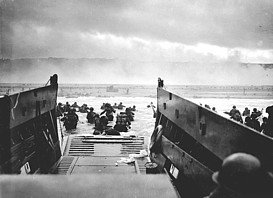
Canada entered World War II independently, but only three days after Britain, declaring war on Germany on September 10, 1939. The U.S. did not enter the war until Japan bombed the U.S. Naval Base at Pearl Harbor on December 7, 1941.
Because Germany and Japan were aggressors and because of the horrors of the Nazi regime's death camps, North Americans have thought of World War II as "the good war." Soldiers returning from World War II battlefields often did not discuss their war experiences with their families, so the extent to which the war left them scarred and why is only now beginning to be openly discussed and understood by the next generation – and written about by historical novelists.
Many authors who lived through World War II wrote novels set during the war years. Except for the occasional classic, no attempt has been made to list these novels, which were contemporary at the time they were written.
Soldiers and Medical Personnel
Click on the title for more information from Powell's Books or another online source, or if you're outside the U.S., try The Book Depository.
Richard Bausch, Peace (2008), a literary novel about three American soldiers on a meaningless mission in Italy during the winter of 1944 after their sergeant murders a woman.
Jerry Jay Carroll, The Great Liars (2014), about an American military officer sent to London as a liaison to Winston Churchill, where he discovers U.S. President Roosevelt is willing to sacrifice the Pacific Fleet in order to get America into World War II.
Patrick Culhane, Red Sky in Morning (2008), about young American officers in 1943 serving under a racist captain on a ship manned with inexperienced African-American sailors.
P. T. Deutermann, Pacific Glory (2011), about two naval officers in love with the same woman, the widow of a friend, and their experiences in the Pacific during World War II.
P. T. Deutermann, Sentinels of Fire (2014), about an officer on a U.S. destroyer under attack from kamikazes who begins to realize the captain is losing his mind.
Sheldon Greene, Burnt Umber (2001), a literary novel about the German painter Franz Marc and a fictional U.S. soldier (loosely based on American artist Harold Paris) who happens upon a sketchbook of his in an abandoned farmhouse at the end of World War II.
W.E.B. Griffin, Semper Fi (1986), about Marine Corps operations in the Pacific Theatre just prior to the start of WWII until immediately after Pearl Harbor; #1 in the Corps series.
W.E.B. Griffin, Call to Arms (1987), about the Marine Corps Raiders attack on Japanese-held Makin Island during early WWII; #2 in the Corps series.
W.E.B. Griffin, Counterattack (1990), about Marine Corps operations in WWII, with a focus on Guadalcanal; #3 in the Corps series.
W.E.B. Griffin, Battleground (1991), about Marine Corps operations in WWII, with a continuing focus on the Guadalcanal attack; #4 in the Corps series.
W.E.B. Griffin, Line of Fire (1993), about Marine Corps special operations in WWII, in support of the Australian Coast Watchers; #5 in the Corps series.
W.E.B. Griffin, Close Combat (1993), about a war bond tour featuring Marine heroes of the Guadalcanal campaign, which conveys the public-relations aspects of modern war; #6 in the Corps series.
W.E.B. Griffin, Behind the Lines (1996), about efforts of Marines to supply American soldiers operating behind the lines in the Philippines; #7 in the Corps series.
W.E.B. Griffin, In Danger's Path (1999), about Marine Corps special operations activities in establishing a weather station in Mongolia; #8 in the Corps series.
Joseph Heller, Catch-22 (1961), a darkly humorous literary novel about American fighter pilots caught in the military bureaucracy during World War II; based on Heller's war experiences, so technically not historical fiction.
Heikki Hietala, Tulagi Hotel (2010), about a U.S. fighter pilot's experiences in World War II and afterward when he builds a hotel in the Solomon Islands.
Sarah Jio, The Bungalow (2011), about an American Army Nurse Corps nurse in Bora-Bora and her love for a soldier she meets there.
Aaron T. Knight, On the Edge of Twilight (2012), a novel of alternate history which imagines how Germany might have won World War II if the Normandy invasion had failed; self-published.
Jim Lehrer, Oh, Johnny (2009), a coming-of-age novel about a young man serving in the Marines and the girl he left behind in Kansas City.
L.Y. Marlow, A Life Apart (2014), about a white naval officer who, after his life is saved by a black sailor during the Pearl Harbor attack, falls in love with the sailor's sister.
James McBride, Miracle at St. Anna (2003), about a group of black American soldiers cut off from their unit in a small Italian village during the winter of 1944.
James Michael Pratt, Ticket Home (2001), about twin brothers who help their father run a railway station in Depression-era Oklahoma, fall in love with the same woman, and fight in the Pacific during World War II.
Adam Lewis Schroeder, Empress of Asia (2008), about a Canadian seaman who falls in love with and marries an Englishwoman in Singapore, and then searches for her across Southeast Asia after they are separated during an air raid.
Jeff Shaara, The Final Storm (2011), about the three-month battle in the Pacific during the spring of 1945.
John Shors, Beside a Burning Sea (2008), about a wounded Japanese soldier who saves an American nurse after a hospital ship is bombed and escapes with her and a few other survivors to a deserted island.
Flora J. Solomon, A Pledge of Silence (2014), about a woman who joins the Army Nurse Corps in 1941 and is sent to Manila, where she spends three years in a Japanese prison camp.
James Spencer, The Pilots (2003), a novel in the form of linked short stories about a group of American pilots fighting in the Pacific during World War II.
Glenn Taylor, The Marrowbone Marble Company (2010), about an 18-year-old factory worker who enlists after Pearl Harbor and his life during the war and afterward when he founds a company that makes glass playing marbles.
Scott Turow, Ordinary Heroes (2005), about a man who discovers his recently deceased father kept many secrets from him, including a World War II court-martial. Review
Simon Van Booy, The Illusion of Separateness (2013), about a variety of people in different times and places whose lives are linked by a soldier's act of mercy during World War II. Review at The Guardian
Ayelet Waldman, Love and Treasure (2014), about a young U.S. officer who takes a pendant from a captured train of Nazi loot, and his granddaughter in the present day, who tries to return the pendant to its rightful owner, a unknown Hungarian woman.
Phil Ward, Those Who Dare (2010), about an American volunteer fighting in the British Army in 1940.
Gene Wilder, Something to Remember You By: A Perilous Romance (2013), a novella about an injured American soldier who falls in love with a mysterious Danish girl while he's convalescing in London.
Burt Zollo, Prisoners (2003), about a young Jewish G.I. who was a football player before the war and is now assigned to guard German prisoners at a POW camp in France.
Spies
Click on the title for more information from Powell's Books or another online source, or if you're outside the U.S., try The Book Depository.
Roger Conlee, The Hindenburg Letter (2008), about an American reporter who sneaks into Nazi Germany during World War II on a personal mission of revenge and reluctantly agrees to act as a spy for the U.S., as well; self-published.
Jorge Volpi Escalante, In Search of Klingsor (2002), about an American physicist assigned to find out who is directing the Nazi research program and the German physicist who assists him, and whose identity comes into question.
W.E.B. Griffin, Honor Bound (1993), about the recruitment and development of an OSS team to carry out a secret mission to disrupt German submarine activity in neutral Argentina during WWII; #1 in the Honor Bound spy series.
W.E.B. Griffin, Blood and Honor (1996), about the efforts of an OSS team operating in Argentina to stop German efforts to move Nazi money into the country during WWII; #2 in the Honor Bound spy series.
W.E.B. Griffin, Secret Honor (1999), about an American OSS agent in Argentina in who gains information about a plot to kill Hitler; #3 in the Honor Bound spy series.
W.E.B. Griffin and William E. Butterworth IV, Death and Honor (2008), about the efforts of the OSS to stop a German plan to set up safe havens in Argentina, Brazil, and Paraguay for top Nazis who realize they have lost the war; 4 in the Honor Bound spy series.
W.E.B. Griffin and William E. Butterworth IV, The Honor of Spies (2009), about OSS operations in Argentina to disrupt German activities in South America; #5 in the Honor Bound spy series.
W.E.B. Griffin and William E. Butterworth IV, Empire and Honor (2012), about an OSS officer confronting the growing threat of Soviet spies as World War II comes to an end; #6 in the Honor Bound spy series.
W.E.B. Griffin, The Last Heroes (1985; originally published under the pen name Alex Baldwin), about "Wild Bill" Donovan, Franklin Roosevelt's law school friend and his choice to head the top-secret OSS during World War II; #1 in the Men at War series.
W.E.B. Griffin, The Secret Warriors (1985; originally published under the pen name Alex Baldwin), about an OSS project to air drop agents into the Belgian Congo to smuggle out uranium ore for an American bomb; #2 in the Men at War series.
W.E.B. Griffin, The Soldier Spies (1986; originally published under the pen name Alex Baldwin), about an OSS project so covert that even the men setting it up aren't sure of its purpose – to find Germans capable of developing an atomic bomb and extract or eliminate them; #3 in the Men at War series.
W.E.B. Griffin, The Fighting Agents (1986; originally published under the pen name Alex Baldwin), about an OSS operation that has reached a stage so sensitive, it may become necessary to order the elimination of American agents before they fall into enemy hands; #4 in the Men at War series.
W.E.B. Griffin and William E. Butterworth, The Saboteurs (2006), about an OSS operation to set up the invasion of Sicily in which they work with unlikely allies: "Lucky" Luciano and the Mob; #5 in the Men at War series.
W.E.B. Griffin and William E. Butterworth, The Double Agents (2007), about an OSS effort to find convincing evidence of a German chemical weapons program that neither the American nor the British leaders believe exists; #6 in the Men at War series.
Joseph Kanon, Istanbul Passage (2012), a thriller about an American businessman who becomes an undercover agent in Istanbul in 1945.
Michael Dana Kennedy, The Flowers of Edo (2010), about a Japanese-American man sent into Japan, where he has a twin brother in the Japanese Imperial Army, with the mission of finding out the Japanese war plans as World War II nears its end.
Jean Sheldon, The Woman in the Wing (2008), about a young woman who joins the World War II WASP program because she wants to fly, but is sent instead to do undercover work in an airplane factory. Brief Critique
Daniel Silva, The Unlikely Spy (1996), about British intelligence efforts in World War II to identify and eliminate a deep-cover Nazi agent looking for the Allied invasion plans.
Seymour Topping, Fatal Crossroads: A Novel of Vietnam 1945 (2005), about an American OSS officer who travels to Vietnam to meet with Ho Chi Minh at the close of World War II.
Frank Yerby, The Voyage Unplanned (1974), about a man searching post-World-War-II France for the Jewish woman he once loved, and about the founding of the OSS after World War II and its adoption of Nazi tactics.
Reporters and Other Civilians Overseas
Click on the title for more information from Powell's Books or another online source, or if you're outside the U.S., try The Book Depository.
Lana McGraw Boldt, Flower of the Pacific (1984), about a Japanese-American woman born in the U.S. and engaged to an American pilot, who is trapped in Japan while visiting relatives when Japan bombs Pearl Harbor, and then forced to broadcast propaganda.
Meg Waite Clayton, The Race for Paris (2015), about an American who hopes to be the first journalist to reach occupied Paris with the Allied army.
Tricia Goyer, Arms of Deliverance (2006), about two young women reporters for the New York Tribune who are friends and competitors when one of them, sent to cover a German bombing raid, becomes lost behind enemy lines; Christian message.
Brian Payton, The Wind Is Not a River (2014), about a Seattle journalist who while covering the war is shot down in the Aleutian Islands, where he struggles to survive, and his wife, who sets out to find him and bring him home.
David L. Robbins, The Broken Jewel (2009), about an American prisoner of war and his son in the Japanese camp at Los Banos, south of Manila in the Philippines, and a young Filipina woman forced to become a prostitute for the camp guards; based on a real-life 1945 rescue mission.
Mysteries
Click on the title for more information from Powell's Books or another online source, or if you're outside the U.S., try The Book Depository.
James R. Benn, Billy Boyle (2006), about a Boston cop whose mother pulls strings to get him a job on General Eisenhower's staff, where his investigation skills are put to work tracking down a spy; #1 in the Billy Boyle World War II mystery series.
James R. Benn, The First Wave (2007), about a Boston cop on General Eisenhower's staff, who must investigate a case of murder during the Allied invasion of Algiers; #2 in the Billy Boyle World War II mystery series.
James R. Benn, Blood Alone (2008), about a Boston cop on General Eisenhower's staff who must carry out a mission to prevent Sicilian mobsters from killing American troops, while he is in a field hospital recovering from amnesia; #3 in the Billy Boyle World War II mystery series.
James R. Benn, Evil for Evil (2009), about a Boston cop on General Eisenhower's staff sent to Northern Ireland in 1943 to investigate a theft of rifles and ammunition from a U.S. Army depot, which may be connected to the murder of an IRA member; #4 in the Billy Boyle World War II mystery series.
James R. Benn, Rag and Bone (2010), about a Boston cop on General Eisenhower's staff sent to London to investigate the murder of a Soviet officer; #5 in the Billy Boyle World War II mystery series.
James R. Benn, A Mortal Terror (2011), about a Boston cop on General Eisenhower's staff who is sent to Italy to investigate an apparent case of serial murder in which the killer leaves a playing card with each body; #6 in the Billy Boyle World War II mystery series.
James R. Benn, Death's Door (2012), about about a former Boston cop on General Eisenhower's staff who is sent to Rome to investigate the murder of an American monsignor at the Vatican; #7 in the Billy Boyle World War II mystery series.
James R. Benn, A Blind Goddess (2013), about an American army officer assigned to investigate the murder of an accountant in an English village, when what he really wants to do is find out who murdered a gunner in an all-African-American unit in which a friend of his is an officer; #8 in the Billy Boyle World War II mystery series.
James R. Benn, The Rest is Silence (2014), about an American army officer investigating the death of an unidentified man whose body washes up on a restricted beach where the D-Day invasion is being rehearsed; #9 in the Billy Boyle World War II mystery series.
James R. Benn, The White Ghost (2015), about an American army officer assigned to investigate the death of an Allied intelligence operative, whose body was found by Lt. Jack Kennedy on the island of Tulagi after the sinking of his PT-109 torpedo boat; #10 in the Billy Boyle World War II mystery series.
James R. Benn, Blue Madonna (2016), about an American army officer wrongly accused of black market dealings who is told he can escape punishment if he takes on the risky assignment of parachuting into a French town behind enemy lines to investigate murders at an Allied safe house; #11 in the Billy Boyle World War II mystery series.
James R. Benn, The Devouring (2017), about an American army officer sent to Switzerland to investigate banks who may be laundering gold looted from Jews in Nazi concentration camps; #12 in the Billy Boyle World War II mystery series.
James R. Benn, Solemn Graves (2018), about an American army officer assigned to investigate the murder of an American officer in a manor near the front lines in Normandy a month after D-Day; #13 in the Billy Boyle World War II mystery series.
Max Allan Collins, The Pearl Harbor Murders (2001), Tarzan author Edgar Rice Burroughs is the sleuth in this mystery, which has him discover the body of a murdered woman while vacationing in Pearl Harbor just before the Japanese attack.
Joseph Kanon, The Good German (2002), about an American journalist who returns to Germany at the end of World War II on a story assignment, hoping to find the woman with whom he had an affair at the beginning of the war, and stumbles on a murder.
Joseph Kanon, The Alibi (2005), a thriller about a U.S. war crimes investigator who falls in love with a Jewish woman while visiting his mother in Venice and finds himself entangled in a web of crimes stemming from the horrors of the war.
Bill Mesce, Officer of the Court (2001), a thriller about an Army lawyer determined to find out who murdered an American fighter pilot whose body washed up on a remote Scottish island.
Troy D. Nooe, The Ocean Forest: Murder in Myrtle Beach (2011), about a recent WWII vet whose inexperience as a private investigator causes problems when he goes to a friend's wedding in South Carolina and comes across a case of murder.
Top of Page
Back to 20th Century Directory
Back to WWII Warfare: Europeans
Forward to WWII Home Front: Europe
Enjoy this page? Please pay it forward. Here's how...
Would you prefer to share this page with others by linking to it?
- Click on the HTML link code below.
- Copy and paste it, adding a note of your own, into your blog, a Web page, forums, a blog comment, your Facebook account, or anywhere that someone would find this page valuable.