|
Medieval Scandinavia and the Vikings
Raiders, Traders and Travelers 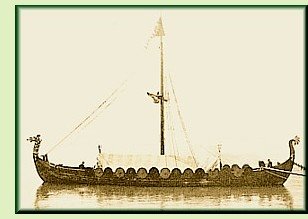
The medieval Vikings were not just the fierce raiders of stereotype, though they did descend on coastal Britain and elsewhere with terrifying raids from longships that could sail a considerable distance upriver. They were also traders who traveled the world, including eastward where they were known as the "Rus" and gave Russia its name. In Constantinople, Viking warriors served as personal guards to the Byzantine emperor, where were known as the Varangian Guard. During the climate crises of the Middle Ages, they fared westward to Iceland, Greenland and even North America, searching for good farmland. Not all medieval Scandinavians raided; most stayed home and pursued lives as farmers, craftsmen and merchants as in the rest of Europe, but in a colder climate that presented special challenges. Beginning in the eighth century, Christian missionaries traveled to Scandinavia, and by the thirteenth century, most Scandinavians had adopted Christianity. A good case can be made that the sagas written by medieval Scandinavians amount to early historical novels, so several are included in the listings.
Raiders, Traders and Travelers
Poul Anderson, The Golden Horn Poul Anderson, The Road of the Sea Horse Poul Anderson, The Sign of the Raven
Al Bas, Harald and the Holy Cross Frans Gunnar Bengtsson, The Long Ships (Swedish edition in two volumes 1941 and 1945; English translation in one volume 1954; the first volume published singly in English as Red Orm in 1943), a humorous adventure novel about tenth-century Viking raiders. Review Farnham Bishop and Arthur Gilchrist Brodeur, In the Grip of the Minotaur George Mackay Brown, Vinland (2005), about a young Viking who voyages from Orkney to Norway, Iceland and Ireland during the shift from paganism to Christianity. Theodore Brun, A Sacred Storm (2018), about an eighth-century Viking warrior who has pledged loyalty to the Swedish king on the eve of a war between Sweden and Denmark, although the Danish king's daughter has fallen in love with him; #1 in the forthcoming Wanderer Chronicles. Michael Crichton, Eaters of the Dead (1976), historical fantasy about a tenth-century Arab explorer in Viking Russia and Britain, based on the historical manuscript of Ibn Fadlan and the epic poem Beowulf. Eric R. Eddison, Styrbiorn the Strong (1926), about a tragic figure from Norse sagas, Styrbiorn Olafsson, an heir to the Swedish throne whose hot temper led to his being denied the kingship. Review Michael Ennis, Byzantium W. Michael Gear and Kathleen O’Neal Gear, People of the Songtrail (2015), about a Viking settlement in America. David Gibbins, Crusader Gold (2006), a novel which imagines that Vikings sacked the Jewish Temple in Jerusalem and tells the story of a modern archaeologist who discovers a map that could lead to the discovery of the Temple treasure. H. Rider Haggard, The Saga of Eric Brighteyes John Halsted, The Legend of the Last Vikings: Taklamakan Linnea Hartsuyker, The Half-Drowned King (2017), about a Viking who barely escapes being murdered when his stepfather betrays him, and his sister, whose opportunity to escape their stepfather is by marrying her brother's rival; #1 in a trilogy. Linnea Hartsuyker, The Sea Queen (2018), about a Viking leader who fights for King Harald of Norway, and his sister, the wife of a rebellious explorer; #2 in a trilogy.
Cecelia Holland, The Witches' Kitchen (2004), historical fantasy about a Viking in Vinland who sets out on a sea voyage in an attempt to make amends for the murder of Eric Bloodaxe; #2 in the Soul Thief series. Review Cecelia Holland, The Serpent Dreamer (2005), historical fantasy about a Viking who returns to Vinland to find his sister caught between this world and the next; #3 in the Soul Thief series. Review Cecelia Holland, Varanger (2008), about two cousins (the son and nephew of the Viking character in the first three novels) who spend a winter among the Rus; #4 in the Soul Thief series. Review Cecelia Holland, The High City Cecelia Holland, Kings of the North (2010), about a man with a psychic sense for water who returns to Viking Jorvik as King Sweyn Forkbeard prepares to overthrow England's King Ethelred II; #6 in the Soul Thief series. Review
Giles Kristian, Sons of Thunder (2010), about a band of Vikings bent on revenge who pursue the man who has stolen their ship; #2 in the Raven series. Review Giles Kristian, Odin's Wolves (2011), about a young Viking warrior on his way to Constantinople, where he hopes to find treasure and fame; #3 in the Raven series. Review Giles Kristian, God of Vengeance Giles Kristian, Winter's Fire (2016), about the leader of a much diminished Viking band and his struggle to avenge himself against a king who is his deadly enemy; #2 in the Rise of Sigurd series. Giles Kristian, Wings of the Storm (2016), about the leader of a Viking band who has been taken captive and is set to be sacrificed when he finds a powerful relic, a spear said to have belonged to the god Odin; #3 in the Rise of Sigurd series.
Snorri Kristjansson, Blood Will Follow (2015), about two Vikings whose encounter with a witch leaves them immortal, amid the struggle between Christians and pagans in medieval Norway; #2 in the Valhalla Saga. Snorri Kristjansson, Path of Gods (2016), about two Viking immortals who oppose King Olav's determination to spread Christianity in Norway; #3 in the Valhalla Saga.
Robert Low, The Wolf Sea Robert Low, The White Raven (2009), about the leader of a group of Viking raiders who must journey into danger to rescue to of their number after a raid on their homestead; #3 in the Oathsworn series. Review Robert Low, The Prow Beast (2010), about a Viking and his band who are forced to flee an attack on their homestead and protect their pregnant queen; #4 in the Oathsworn series. Review Robert Low, Crowbone (2012), about the true heir to the throne of Norway and his struggle to defeat his enemy, "the Witch Mother of Kings," and gain the throne; #5 in the Oathsworn series. Review
Bruce Macbain, Ice Queen (2016), about an eleventh-century Viking who serves as a skald in the land of the Rus, where he has an affair with a princess and breaks with Harald, his sworn lord; #2 in the Odd Tangle-Hair Saga series. Juliet Marillier, Wolfskin (2002), historical fantasy about a young Viking who takes part in an expedition to the Orkey Isles, where he falls in love with a princess. Juliet Marillier, Foxmask (2005), historical fantasy about a Viking whose peaceful rule in the Orkney Isles is threatened by the son of the previous king; sequel to Wolfskin. Edison Marshall, The Viking Connie Mason, Lord of Fire and Ice
James L. Nelson, Dubh-Linn James L. Nelson, The Lord of Vik-Ló
Tim Severin, Sworn Brother (2005), about an eleventh-century Viking's adventures, ranging from England to Byzantium; #2 in the Viking trilogy. Tim Severin, King's Man (2005), about a Viking who takes part in the Norman conquest of England; #3 in the Viking trilogy.
Medieval Sweden, Norway, Denmark and Misc.
Poul Anderson, Hrolf Kraki's Saga Poul Anderson, Mother of Kings (2001), about the Norse chieftain's daughter who becomes the wife of Eirlik Blood-Axe; based on Norse sagas. Review Poul Anderson, War of the Gods (1997), about the adventures of Hadding of Denmark; based on medieval Norse sagas. Review
Bernard King, Vargr-Moon (1986), based on early Danish sagas; #2 in the Starkadder trilogy. Bernard King, Death-Blinder
Connie Mason, Lord of Fire and Ice Eric Schumacher, God's Hammer Snorri Sturluson, Heimskringla (ca. 1230), a collection of medieval sagas about the early Norse kings. Review
Sigrid Undset, The Bridal Wreath (Norwegian edition 1920; first English translation 1923; also titled The Wreath), about a woman in fourteenth century Norway, by an author who won the Nobel prize; #1 in the Kristin Lavransdatter trilogy. Review Sigrid Undset, The Mistress of Husaby (Norwegian edition 1921; first English translation 1925), about a woman in fourteenth century Norway, by an author who won the Nobel prize; #2 in the Kristin Lavransdatter trilogy. Sigrid Undset, The Cross (Norwegian edition 1922; first English translation 1927), about a woman in fourteenth century Norway, by an author who won the Nobel prize; #3 in the Kristin Lavransdatter trilogy. Sigrid Undset, The Axe (English translation 1928), about a man and woman in medieval Norway who were betrothed as children but must fight to be wedded after plans change and they are expected to marry other people; #1 in the Master of Hestviken quartet. Sigrid Undset, The Snake Pit (English translation 1929), about a young married couple in medieval Norway who are burdened by guilt; #2 in the Master of Hestviken quartet. Sigrid Undset, In the Wilderness (English translation 1929), about a wealthy and respected widower in medieval Norway whose guilt leads him to a life at sea; #3 in the Master of Hestviken quartet. Sigrid Undset, The Son Avenger (English translation 1930), about an elderly widower in medieval Norway who must watch his children repeat the tragic mistakes he once made himself; #4 in the Master of Hestviken quartet.
Vikings in Iceland, Greenland and North America
Anonymous, Njal's Saga (circa 1270 to 1290), an Icelandic saga about a blood feud between two families in Iceland. Review Anonymous, The Saga of the People of Laxardal (13th century), an Icelandic saga about a woman who settles in Iceland and several generations of her descendents. Review Joan Clark, Eiriksdottir: A Tale of Dreams and Luck (1994), about the Viking expedition to Vinland on the American continent from the perspective of the daughter of the expedition's leader. Bernard du Boucheron, The Voyage of the Short Serpent (2008), a darkly humorous story about a medieval bishop sent to a doomed Catholic colony on Greenland to collect tithes and punish sinners. Vilborg Davidsdottir, On the Cold Coasts Margaret Elphinstone, The Sea Road (2000), about the Viking expedition to Vinland on the American continent from the perspective of a Viking woman. Review Cecelia Holland, Two Ravens Tom Holt, Meadowland: A Novel of the Viking Discovery of America (2005), a humorous story of the Vinland discovery, narrated by a Scandinavian soldier in the Byzantine Varangian Guard. Jeff Janoda, Saga: A Novel of Medieval Iceland (2005), set in medieval Iceland. Tim Leach, Smile of the Wolf (2018), about two friends in tenth-century Iceland who, after killing a man, must struggle to survive as exiles from their community in a harsh landscape. Judith Lindbergh, The Thrall’s Tale (2006), a literary novel of a woman's revenge, set in medieval Greenland. Nevil Shute, An Old Captivity (1940; also titled Vinland the Good), about a pilot hired to make an aerial survey of Greenland whose dreams about life as a Viking slave include important historical details. Jane Smiley, The Greenlanders (1988), about a family in the Norse colony in Greenland during its decline. Snorri Sturluson, Egil's Saga (about 1240 A.D.), a medieval Icelandic saga about a rebellious Viking, beginning with his father's life in Norway and migration to Iceland. Review Betsy Tobin, Ice Land William Vollmann, The Ice Shirt (1990), about the Viking discovery of Vinland in North America; #1 in the Seven Dreams series (see 17th Century page for others in the series).
Top of Page
|
 (1980), about Harald Hardrede (also spelled Hardrada) and his struggle to become king of Norway in the eleventh century; #1 in the Last Viking trilogy.
  (1980), about Harald Hardrede's efforts to become sole king of Norway and conquer Denmark; #2 in the Last Viking trilogy.
  (1980), about Harald Hardrede's final years and his attempt to become king of England; #3 in the Last Viking trilogy.
  (2008), a thriller about the Norwegian Prince Harald Hardrada during his period of exile in Constantinople; self-published.
 (1916 as a magazine serial; 2010 in book form), about a band of Vikings who journey into the Mediterranean and experience Troy and Minoan Crete. (Set in ancient, not medieval times, but the listing seems to fit better on this page than on the Ancient History page.)
 (1990), about the eleventh-century Norse prince Harald Sigurdarsson (later to become Harald Hardrada, King of Norway) during the time he served in the Byzantine Emperor's Varangian Guard.
 (1891), an adventure story about a Viking and his efforts to win the woman he loves in the face of obstacles ranging from her reluctant parents, a rival suitor, and the woman's half-sister, who wants him for herself.
 (2009), about a traveler who draws the dangerous attention of Emperor Basil II amid a war between Basil and a potential usurper; #5 in the Soul Thief series.
  (2008), historical fantasy based on the Old English epic "Beowulf," about a Norse hero who sets out to avenge the murder of his father; self-published.
 (2014), about a young man in eighth-century Norway who gathers a band of warriors to avenge his father's murder; #1 in the Rise of Sigurd series.
  (2010), historical fantasy about two brothers kidnapped as infants and raised by Vikings; based on a Norse myth.
  (2008), about the young leader of a band of Viking raiders trying to regain his legendary, rune-inscribed sword after it is stolen by a dangerous enemy; #2 in the Oathsworn series.
  (1951), an adventure story; the 1958 movie "The Vikings" starring Kirk Douglas and Tony Curtis was based on this novel.
  (2012), historical romance about a hot Viking warrior tricked into slavery and his mistress, sworn to avenge her husband's death.
 (2012), about a ninth-century Viking crew who plunder an Irish ship and find themselves battling not only the Irish but also the Danes in control of Dublin; self-published; #1 in the Norsemen Saga.
  (2014), about a Viking leader and his band of raiders who become involved in an Irish struggle over Tara; self-published; #2 in the Norsemen Saga.
  (2015), about a Viking leader and his band whose longship is driven to the Irish settlement of Vik-Ló during a storm, where they become involved in conflict over a missing treasure; self-published; #3 in the Norsemen Saga.
  (2005), about a son of Leif Ericson and a Celtic mother who arrives in Greenland in 1001, is raised as a pagan, and fights against Brian Boru in the Battle of Clontarf; based on the Eyrbyggja Saga; #1 in the Viking trilogy.
 (2004), about a tenth-century pagan Norseman and his travels to Constantinople and across the Atlantic.
 (1973), historical fantasy based on the medieval Norse saga of Hrolf Kraki.
 (1985), based on early Danish sagas; #1 in the Starkadder trilogy.

 (1977), about a young man in twelfth-century Iceland who leaves home to get away from his violent father but feels the need to return.
 (2009), literary historical fantasy about Freya, the Norse goddess of love, and a human woman who falls in love with a man from an enemy clan in Iceland at the turn of the first millennium.