|
Novels of the Late 13th, 14th and 15th Centuries in Europe:Including the Plantagenet Kings of England, the Hundred Years' War and Joan of Arc
Jump to: Edward I to the Wars of the Roses Edward I to the Wars of the Roses
King Edward I (popularly known as "Longshanks" because of his unusual height) ascended to the throne of England in 1272. He pursued aggressive military policies against Wales and Scotland, both of which were essentially under English control by the end of the thirteenth century. (See the Medieval Celts page for novels set in Wales and Scotland during his reign.) His son, Edward II succeeded him in 1307 and continued to make war against Scotland. Edward III began the Hundred Years' War with his claim to the French throne. His grandson Richard II (the son of Edward the Black Prince and Joan of Kent) was only 10 when his grandfather died, leaving him king. During his minority, John of Gaunt (would would father an ancestor of the Tudor kings with his mistress Katherine Swynford) served as regent. Henry IV and Henry V, renowned from Shakespeare's plays, would continue the war against France. Under Henry VI, England lost the Hundred Years' War. This weak and mentally unstable king set the stage for the Wars of the Roses.
Vanessa Alexander, The Love Knot (1999), a love story about Edward II's sister Joan of Acre and her second husband, Ralph de Monthermer. Prudence Andrew, The Hooded Falcon Prudence Andrew, A Sparkle from the Coal Elizabeth Ashworth, An Honourable Estate Margaret Campbell Barnes, Within the Hollow Crown Margaret Campbell Barnes, Isabel the Fair Maggie Bennett, Strangers and Pilgrims (2010), about a young lawyer who becomes a Franciscan friar after his wife dies in 1340, a decision called into question when he meets the attractive daughter of an impoverished knight. Maggie Bennett, Every Noble Knight (2012), about a young English knight injured in the Battle of Poitiers who falls in love with a girl whose father insists they wait four years after their betrothal to marry; Christian message. Vanora Bennett, The Queen's Lover (2009; also titled Blood Royal), about Catherine de Valois, the widow of King Henry V and future grandmother of Henry VII, and her love for the Welsh commoner Owen Tudor. Pamela Bennetts, She-Wolf D.J. Birmingham, The Queen's Tale (2007), historical fantasy about a centuries-old brooch in which the soul of an Irish queen is imprisoned, and the fourteenth-century leaders of England and Scotland who wish to possess it; self-published. Brief critique Emma Campion, The King's Mistress (2009), a sympathetic novel about Alice Perrers, the widely disliked mistress of King Edward III. Review Emma Campion, A Triple Knot (2014), about Joan of Kent, a cousin of King Edward III, and her secret marriage despite the king's negotiations to marry her to an ally of his after he begins a war against France. David Charles, The Switch Will Davenport, The Sinner's Tale (2005; also titled The Perfect Sinner), about a British woman who returns to her home village after her political career is derailed, where she discovers the tale of a fifteenth-century knight and slips back in time to meet her ancestors. Daphne du Maurier, The House on the Strand (1969), about a man who can't resist time-traveling into fourteenth-century Cornwall despite the danger. Michael Eardley, Letter from Poitou (2004), about Eve de Clavering and her life as a lady-in-waiting to Queen Isabella at the courts of Edward II and Edward III; self-published. Jean Evans, Brittle Glory (1977), a sympathetic novel about Queen Isabella, the wife of Edward II. Eleanor Fairburn, The Green Popinjays Colin Falconer, Isabella: Braveheart of France (2013), about the French Princess Isabella, betrothed at age twelve to Edward II of England, who discovers she cannot compete with his favorite Piers Gaveston. Edith Felber, Queen of Shadows Ken Follett, World Without End (2007), a sequel to Pillars of the Earth which can be read as a stand-alone novel; set in fourteenth-century England. Review Denise Giardina, Good King Harry (1984), a novel about King Henry V written in the form of an autobiography. Blythe Gifford, The Harlot's Daughter (2007), historical romance about a daughter of Edward III and his notorious mistress Alice Perrers. William Golding, The Spire (1964), about a fourteenth-century dean of Salisbury Cathedral who becomes obsessed with adding a tall spire to the cathedral despite warnings that the building is not strong enough to support it. Alice Walworth Graham, The Vows of the Peacock Karen Harper, The First Princess of Wales (2006), the romantic fourteenth-century story of Joan of Kent and Edward the Black Prince.
Cynthia Harrod-Eagles, The Dark Rose (1981), about a great-grandson of the couple who marry in The Founding, the enmity between his two sons, one legitimate and one not, and his niece who becomes a maid-in-waiting to Anne Boleyn; #2 in the Morland Dynasty series. Cynthia Harrod-Eagles, The Princeling (1981; also titled The Distant Wood), about a Catholic family and the challenges they face as England becomes a Protestant country; #3 in the Morland Dynasty series. Cynthia Harrod-Eagles, The Oak Apple (1982), about two brothers, one of whom fights in the Royalist army under Prince Rupert, while the other marries a Puritan; #4 in the Morland Dynasty series. Cynthia Harrod-Eagles, The Black Pearl (1982), about a family's attempt to regain its wealth and position after the devastation of the English Civil War as the Commonwealth period comes to an end; #5 in the Morland Dynasty series. Cynthia Harrod-Eagles, The Long Shadow (1983), about the changing fortunes of an English family when Charles II dies and the accession of James II, a Catholic, reawakens religious conflicts; #6 in the Morland Dynasty series. Cynthia Harrod-Eagles, The Chevalier (1984), about a woman who follows James II into exile, leaving her grandson, who makes an unwise marriage, in charge of the family estate; #7 in the Morland Dynasty series. Cynthia Harrod-Eagles, The Maiden (1985), about a man who marries to safeguard the family estate, and his intelligent daughter, who struggles to preserve it in spite of her dissolute husband; #8 in the Morland Dynasty series. Cynthia Harrod-Eagles, The Flood Tide (1986), about three branches of a family, one restoring their fortunes under George III, another involved in the brewing American Revolution, and a third living in France as tensions rise that will lead to another revolution; #9 in the Morland Dynasty series. Cynthia Harrod-Eagles, The Tangled Thread (1987), about an English family's illegitimate scion living in France, where he tries desperately to protect himself and his daughter from the guillotine amid the French Revolution; #10 in the Morland Dynasty series. See the Napoleonic page for #11-14.
Joanna Hickson, The Agincourt Bride Susan Higginbotham, The Traitor's Wife: A Novel of the Reign of Edward II (2005), about Eleanor de Clare, a niece of Edward II and wife of the notorious Hugh le Despenser, charged with treason when Queen Isabella and Roger Mortimer depose the king. Review Susan Higginbotham, Hugh and Bess: A Love Story (2007), about Eleanor de Clare's son Hugh and his wife Bess, reluctant partners in an arranged marriage in the time of King Edward III; sequel to The Traitor's Wife. See Review or Interview with Susan Higginbotham Daisy Hildyard, Hunters in the Snow Brenda Honeyman, The Queen and Mortimer (1974), a sympathetic novel about Edward II, his queen Isabella, and her lover Roger Mortimer; followed by a prequel, The King's Minions. Brenda Honeyman, The King's Minions (1974), about the love affair between Edward II and Piers Gaveston; prequel to The Queen and Mortimer. Chris Hunt, Gaveston Rosemary Hawley Jarman, Crown in Candlelight (1978), about Katherine of Valois, the ancestress of the Tudor kings. Dedwydd Jones, The Lily and the Dragon Annelise Kamada, A Love So Bold Annelise Kamada, A Banner Red and Gold Janet Kilbourne, Where Nobles Tread Jane Lane, A Secret Chronicle Janet Lane, Tabor's Trinket Janet Lane, Emerald Silk (2008), historical romance about a half-Gypsy woman raised by nobility and the Gypsy tribal king she marries in fifteenth-century England; #2 in the Coin Forest series. Jennifer Lang, The Crowning City Hilda Lewis, Wife to Henry V Hilda Lewis, I, Jacqueline (1957; reissued 2008), about Jacqueline of Hainault, a fifteenth-century Flemish noblewoman whose marriages plunged her into the midst of the power politics of her time. Hilda Lewis, Harlot Queen (1970), about Isabella of France, the wife of King Edward II.
Norah Lofts, The House at Old Vine Norah Lofts, The House at Sunset Norah Lofts, The Maude Reed Tale Norah Lofts, Knight's Acre Norah Lofts, The Homecoming Norah Lofts, The Lonely Furrow
Karen Maitland, The Owl Killers (2009), a thriller about an English village terrorized by its overlords, when a group of nuns with a special gift for farming arrive and take in a young woman whose mysterious death leads to accusations of witchcraft. Karen Maitland, The Gallows Curse Karen Maitland, A Gathering of Ghosts (2018; titled The Blood Well in the U.S.), about the nuns in a Dartmoor priory in 1316 where people journey to seek healing at the holy well, and the horrors unleashed when three strangers arrive, a young woman, a Knight of St John and a blind child. A.M. Maughan, Harry of Monmouth Ralph Milton, Julian's Cell: The Earthy Story of Julian of Norwich (2002), about the fourteenth-century anchorite and mystic Julian of Norwich (an anchorite is a nun walled into a small cell attached to a church for the rest of her life). Douglas Nicholas, Something Red (2012), historical fantasy about a thirteenth-century Irish healer and her troupe stalked by a supernatural being as they travel through the coldest winter of their lives. Robert Nye, Falstaff (2001), a bawdy novel of medieval England narrated by the Shakespearean character Falstaff. Anne O'Brien, The King's Concubine (2012), about Alice Perrers, the mistress of King Edward III. Evan Ostryzniuk, Of Faith and Fidelity Edith Pargeter, A Bloody Field by Shrewsbury (1972; also titled The Bloody Field in the U.S.), about Henry IV, the friendship between his son Hal and Harry "Hotspur" Percy, and the disputes leading up to the 1403 Battle of Shrewsbury near the Welsh border. Review John Colin Penford, The Gascon Maureen Peters, Isabella, the She-Wolf Maureen Peters, My Philippa (1984), about Queen Philippa, the wife of Edward III; out of print and not readily available. Jean Plaidy, The Queen from Provence (1979), about Eleanor of Provence, the wife of King Henry III of England; #6 in the Plantagenet series. Jean Plaidy, Edward Longshanks Jean Plaidy, The Follies of the King (1980), about Edward II, his favorites Piers Gaveston and Hugh Despenser, and his wife Isabella; #8 in the Plantagenet series. Jean Plaidy, The Vow on the Heron Jean Plaidy, The Passage to Pontefract Jean Plaidy, The Star of Lancaster Jean Plaidy, Epitaph for Three Women Brandy Purdy, The Confession of Piers Gaveston (2007), about the love affair between King Edward II and Piers Gaveston; self-published. Charles Reade, The Cloister and the Hearth (1861), a tragic love story about the parents of Erasmus, Margaret and Gerard Brandt, who were separated when Gerard, traveling in Europe, was falsely informed his wife Margaret was dead.
Margaret Redfern, The Storyteller's Granddaughter Margaret Redfern, The Heart Remembers
Judith Merkle Riley, A Vision of Light (1988), about a woman in fourteenth-century England; #1 in the Margaret of Ashbury series. Judith Merkle Riley, In Pursuit of the Green Lion (1990), about a woman in fourteenth-century England; #2 in the Margaret of Ashbury series. Judith Merkle Riley, The Water Devil (1992), about a woman in fourteenth-century England; #3 in the Margaret of Ashbury series. Martha Rofheart, Fortune Made His Sword Anya Seton, Katherine (1954), about Katherine Swynford, the mistress of John of Gaunt and ancestress of the Plantagenet kings of England. Review Eve Trevaskis, The Lord of Misrule Eve Trevaskis, King's Wake (1977), a novel based on the theory that Edward II survived his overthrow and lived into the reign of his son; out of print and not readily available. Brenda Rickman Vantrease, The Illuminator (2005), about a woman in fourteenth-century England during the time of John Wycliff and the controversy over his English translation of the Bible. Brenda Rickman Vantrease, The Mercy Seller (2007), about a fifteenth-century priest uncomfortable with his role as a seller of indulgences and a young Lollard woman trained as a copyist whose lives intersect in France; sequel to The Illuminator. Philippa Wiat, Queen-Gold Penelope Wilcock, The Hawk and the Dove Trilogy Jay Williams, The Good Yeoman Sandra Wilson, Alice (1976), about a woman who becomes the mistress of Piers Gaveston.
Mysteries and Thrillers: 14th-15th Century British Isles
Some exceptionally prolific mystery novelists have set series in fourteenth-century England. Series mysteries by Paul Doherty (who has also used the pen names P.C. Doherty and Paul Harding, among others), Margaret Frazer, Susanna Gregory, Michael Jecks, Jay Margrave, Pat McIntosh, Candace Robb, Mel Starr, and Jeri Westerson appear in this section, as well as stand-alone mysteries by Tim Hodkinson, Sheri Holman, S.D. Sykes and Barry Unsworth. Click on the author's name above to jump to that author's books.
P.C. Doherty, The Crown in Darkness P.C. Doherty, Spy in Chancery P.C. Doherty, Angel of Death (1989), about a clerk for King Edward I who solves mysteries; set in the late thirteenth century; #4 in the Hugh Corbett mystery series P.C. Doherty, Prince of Darkness (1992), about a clerk for King Edward I who solves mysteries; set in the late thirteenth century; #5 in the Hugh Corbett mystery series. P.C. Doherty, Murder Wears a Cowl P.C. Doherty, The Assassin in the Greenwood P.C. Doherty, The Song of a Dark Angel (1994), about a clerk for King Edward I who solves mysteries; set in the late thirteenth century; #8 in the Hugh Corbett mystery series. P.C. Doherty, Satan's Fire P.C. Doherty, The Devil's Hunt P.C. Doherty, The Demon Archer (1999), about a clerk for King Edward I who solves mysteries; set in the late thirteenth century; #11 in the Hugh Corbett mystery series. P.C. Doherty, The Treason of the Ghosts P.C. Doherty, Corpse Candle P.C. Doherty, The Magician's Death P.C. Doherty, The Waxman Murders P.C. Doherty, Nightshade (2008), about an official in the court of King Edward I who is sent on a mission to Essex, where he finds a serial killer spreading terror; #16 in the Hugh Corbett mystery series. Paul Doherty, The Mysterium (2010), about a clerk for King Edward I in 1304 who must investigate the murder of a man in sanctuary by a serial killer; #17 in the Hugh Corbett mystery series.
Paul Doherty (under the pen name of Paul Harding), The House of the Red Slayer (1992), a friar in fourteenth-century London solves mysteries; #2 in the Sorrowful Mysteries of Brother Athelstan series. Paul Doherty (under the pen name of Paul Harding), Murder Most Holy Paul Doherty (under the pen name of Paul Harding), The Anger of God Paul Doherty (under the pen name of Paul Harding), By Murder's Bright Light Paul Doherty (under the pen name of Paul Harding), The House of Crows Paul Doherty (under the pen name of Paul Harding), The Assassin's Riddle Paul Doherty, The Devil's Domain Paul Doherty, The Field of Blood Paul Doherty, The House of Shadows Paul Doherty, Bloodstone (2011), about a friar who must solve the mystery of a London merchant found dead in a locked room amid rumors that the man, a former knight, was cursed for taking a sacred relic from a French abbey; #11 in the Sorrowful Mysteries of Brother Athelstan series. Paul Doherty, The Straw Men (2012), about a friar who must investigate the beheading murder of two men during a mystery play by John of Gaunt's pesonal troupe; #12 in the Sorrowful Mysteries of Brother Athelstan series. Paul Doherty, Candle Flame (2014), about a monk asked to investigate the murder of the king's tax collector and his escort amid the stirrings of Wat Tyler's Rebellion; #13 in the Sorrowful Mysteries of Brother Athelstan series.
P.C. (Paul) Doherty, A Tapestry of Murders P.C. (Paul) Doherty, A Tournament of Murders Paul Doherty, Ghostly Murders Paul Doherty, The Hangman's Hymn Paul Doherty, A Haunt of Murder
Paul Doherty, The Poison Maiden (2007), about a lady in the service of Queen Isabella of England who tries to discover the identity of a dangerous spy for King Philip of France in King Edward II's English court; #2 in the Mathilde of Westminster series. Paul Doherty, The Darkening Glass (2009), about a lady in the service of Queen Isabella of England who must find a murderer as threats to Edward II's rule arise from Scotland as well as within England in 1312; #3 in the Mathilde of Westminster series.
P.C. Doherty, The Serpent Amongst the Lilies (1990), about Joan of Arc and the mysteries surrounding her from the English perspective; #2 in the Matthew Jankyn mystery series. P.C. Doherty, The Death of a King
Margaret Frazer, The Servant's Tale (1993), a Benedictine nun in fifteenth-century England solves mysteries; #2 in the Sister Frevisse Medieval Mysteries series. Margaret Frazer, The Outlaw's Tale Margaret Frazer, The Bishop's Tale Margaret Frazer, The Boy's Tale (1995), a Benedictine nun in fifteenth-century England solves mysteries; #5 in the Sister Frevisse Medieval Mysteries series. Margaret Frazer, The Murderer's Tale (1996), a Benedictine nun in fifteenth-century England solves mysteries; #6 in the Sister Frevisse Medieval Mysteries series. Margaret Frazer, The Prioress' Tale (1997), a Benedictine nun in fifteenth-century England solves mysteries; #7 in the Sister Frevisse Medieval Mysteries series. Margaret Frazer, The Maiden's Tale Margaret Frazer, The Reeve's Tale Margaret Frazer, The Squire's Tale Margaret Frazer, The Clerk's Tale Margaret Frazer, The Bastard's Tale (2003), a Benedictine nun in fifteenth-century England solves mysteries; #12 in the Sister Frevisse Medieval Mysteries series. Margaret Frazer, The Hunter's Tale (2004), a Benedictine nun in fifteenth-century England solves mysteries; #13 in the Sister Frevisse Medieval Mysteries series. Margaret Frazer, The Widow's Tale (2005), a Benedictine nun in fifteenth-century England solves mysteries; #14 in the Sister Frevisse Medieval Mysteries series. Margaret Frazer, The Sempster's Tale (2006), a Benedictine nun in fifteenth-century England solves mysteries; #15 in the Sister Frevisse Medieval Mysteries series. Margaret Frazer, The Traitor's Tale (2007), a Benedictine nun in fifteenth-century England solves mysteries; #16 in the Sister Frevisse Medieval Mysteries series. Margaret Frazer, The Apostate's Tale (2008), murder threatens in the turmoil stirred up by the return of a former nun and her illegitimate child; #17 in the Dame Frevisse mystery series. Margaret Frazer, A Play of Isaac (2004), a traveling player in fifteenth-century England solves mysteries; #1 in the Joliffe Player Mysteries series. Margaret Frazer, A Play of Dux Moraud (2005), a traveling player in fifteenth-century England solves mysteries; #2 in the Joliffe Player Mysteries series. Margaret Frazer, A Play of Knaves (2006), a traveling player in fifteenth-century England solves mysteries; #3 in the Joliffe Player Mysteries series. Margaret Frazer, A Play of Lords (2007), a traveling player in fifteenth-century England solves mysteries; #4 in the Joliffe Player Mysteries series. Margaret Frazer, A Play of Treachery (2009), a traveling player in fifteenth-century England encounters murder when he goes to France to train as a spy in the household of a widowed duchess; #5 in the Joliffe Players mystery series. Margaret Frazer, A Play of Piety (2010), a traveling player in fifteenth-century England must take work in a hospital where a difficult patient insists someone is trying to murder her; #6 in the Joliffe Players mystery series. Margaret Frazer, A Play of Heresy (2011), about a traveling player who investigates the case of a missing person in Coventry, where a sect of heretics are working against the Church; #7 in the Joliffe Players mystery series.
C.L. Grace, The Eye of God C.L. Grace, The Merchant of Death C.L. Grace, The Book of Shadows C.L. Grace, Saintly Murders C.L. Grace, A Maze of Murders C.L. Grace, A Feast of Poisons
Susanna Gregory, An Unholy Alliance (1996), a physician in 1350 Cambridge who is struggling to train new physicians after the plague has decimated the population, when the murder of a friar plunges him into an investigation of a mysterious sect who may be seeking to overthrow the established religion; #2 in the Chronicles of Matthew Bartholomew series. Susanna Gregory, A Bone of Contention (1997), a physician in 1392 Cambridge investigates the connections between a discovery of old bones and the death of a college student; #3 in the Chronicles of Matthew Bartholomew series. Susanna Gregory, A Deadly Brew (1998), a physician in fourteenth-century Cambridge investigates murder amid increasing tensions between the college, Church and town; #4 in the Chronicles of Matthew Bartholomew series. Susanna Gregory, A Wicked Deed (1999), a physician in fourteenth-century Cambridge investigates the death of a scholarly priest when they travel to Suffolk; #5 in the Chronicles of Matthew Bartholomew series. Susanna Gregory, A Masterly Murder (2000), a physician in fourteenth-century Cambridge investigates the death of an unpopular new Master of the fledgling university; #6 in the Chronicles of Matthew Bartholomew series. Susanna Gregory, An Order for Death (2001), a physician in fourteenth-century Cambridge investigates murder amid a theological controversy; #7 in the Chronicles of Matthew Bartholomew series. Susanna Gregory, A Summer of Discontent (2002), a physician in fourteenth-century Cambridge investigates a series of murders when he travels to Ely to visit its library; #8 in the Chronicles of Matthew Bartholomew series. Susanna Gregory, A Killer in Winter (2003), a physician in fourteenth-century Cambridge investigates the murder of the husband of the woman he once loved; #9 in the Chronicles of Matthew Bartholomew series. Susanna Gregory, The Hand of Justice (2004), a physician in fourteenth-century Cambridge investigates two deaths after the return of a pair of pardoned but unrepentent murderers; #10 in the Chronicles of Matthew Bartholomew series. Susanna Gregory, The Mark of a Murderer (2005), a fourteenth-century physician investigates murders in Cambridge following a riot in Oxford; #11 in the Chronicles of Matthew Bartholomew series. Susanna Gregory, The Tarnished Chalice (2006), a physician from fourteenth-century Cambridge investigates a murder in Lincoln that may be connected to a relic with a bloody past; #12 in the Chronicles of Matthew Bartholomew series. Susanna Gregory, To Kill or Cure (2007), a physician in fourteenth-century Cambridge finds himself in danger when a rival physician arrives in town with a practice involving magic; #13 in the Chronicles of Matthew Bartholomew series. Susanna Gregory, The Devil's Disciples (2008), a physician in fourteenth-century Cambridge investigates murders that appear to be the work of a mysterious sorcerer; #14 in the Chronicles of Matthew Bartholomew series. Susanna Gregory, A Vein of Deceit (2009), a physician in fourteenth-century Cambridge investigates a web of financial fraud; #15 in the Chronicles of Matthew Bartholomew series. Susanna Gregory, The Killer of Pilgrims (2010), about a physician who must investigate the death of a wealthy man amid a rash of increasingly dangerous practical jokes; #16 in the Chronicles of Matthew Bartholomew series. Susanna Gregory, Mystery in the Minster (2011), about a physician sent with a deputation to Cambridge to investigate a rival claim to a legacy and discovers a series of unexplained deaths; #17 in the Chronicles of Matthew Bartholomew series. Susanna Gregory, Murder by the Book (2012), about a physician who must investigate a murder shortly before Cambridge University's new library is to open; #18 in the Chronicles of Matthew Bartholomew series. Susanna Gregory, The Lost Abbott (2013), about a physician sent to Peterborough in 1358 to investigate the disappearance of an abbott; #19 in the Chronicles of Matthew Bartholomew series. Susanna Gregory, Death of a Scholar (2014), about a physician who must find out who killed a junior proctor of the university in Cambridge, with the scholars and the townsfolk each blaming the other for the murder; #20 in the Chronicles of Matthew Bartholomew series. Susanna Gregory, A Poisonous Plot (2015), about a Cambridge physician who must investigate the murder of a tradesman amid conflict between the college and the gown; #21 in the Chronicles of Matthew Bartholomew series. Susanna Gregory, A Grave Concern (2016), about a Cambridge physician who must find a killer at large in the University while a new Chancellor is being selected from an unusually large number of applicants; #22 in the Chronicles of Matthew Bartholomew series.
Sheri Holman, A Stolen Tongue (1997), a mystery novel about a fifteenth-century religious pilgrimage. Bruce Holsinger, A Burnable Book (2014), a thriller about a poet asked by Geoffrey Chaucer to find the manuscript of a book predicting the assassination of King Richard II; #1 in the John Gower series. Bruce Holsinger, The Invention of Fire (2015), a thriller about a poet and trader of secrets who investigates, with the help of Geoffrey Chaucer, the deaths of sixteen men found with shocking wounds, possibly caused by a new invention known as a "handgonne;" #2 in the John Gower series.
Michael Jecks, The Merchant's Partner (1995), two noblemen in fourteenth-century Devon investigate the murder of a midwife and healer suspected of being a witch; #2 in the Baldwin de Furnshill mystery series. Michael Jecks, A Moorland Hanging (1996), two noblemen in fourteenth-century Devon investigate the death of a serf; #3 in the Baldwin de Furnshill mystery series. Michael Jecks, The Crediton Killings (1997), two noblemen in fourteenth-century Devon investigate the murders that follow the arrival of a band of mercenaries; #4 in the Baldwin de Furnshill mystery series. Michael Jecks, The Abbot's Gibbet (1998), two noblemen in fourteenth-century Devon investigate a murder during the Tavistock Fair; #5 in the Baldwin de Furnshill mystery series. Michael Jecks, The Leper's Return (1998), two noblemen in fourteenth-century Devon investigate the murder of a goldsmith; #6 in the Baldwin de Furnshill mystery series. Michael Jecks, Squire Throwleigh's Heir Michael Jecks, Belladonna at Belstone Michael Jecks, The Traitor of St. Giles Michael Jecks, The Boy-Bishop's Glovemaker Michael Jecks, The Tournament of Blood Michael Jecks, The Sticklepath Strangler Michael Jecks, The Devil's Acolyte Michael Jecks, The Mad Monk of Gidleigh Michael Jecks, The Templar's Penance Michael Jecks, The Outlaws of Ennor Michael Jecks, The Tolls of Death Michael Jecks, The Chapel of Bones Michael Jecks, The Butcher of St. Peter's (2005), two noblemen try to find and stop a serial killer in Exeter; #19 in the Baldwin de Furnshill mystery series. Michael Jecks, A Friar's Bloodfeud (2006), two noblemen investigate a family's murder; #20 in the Baldwin de Furnshill mystery series. Michael Jecks, The Death Ship of Dartmouth (2006), two noblemen investigate a pirate attack that may be more sinister than it seems; #21 in the Baldwin de Furnshill mystery series. Michael Jecks, The Malice of Unnatural Death (2007), two noblemen in service to King Edward II investigate the killing of a royal messenger; #22 in the Baldwin de Furnshill mystery series. Michael Jecks, Dispensation of Death (2007), two noblemen in service to King Edward II are assigned to find out who murdered a lady-in-waiting and a man whose body was found behind the throne; #23 in the Baldwin de Furnshill mystery series. Michael Jecks, The Templar, the Queen and Her Lover (2008), two noblemen in fourteenth-century Devon investigate murders; #24 in the Baldwin de Furnshill mystery series. Michael Jecks, The Prophecy of Death (2008), two noblemen in service to King Edward II return from France in 1325 to find themselves in the midst of deadly court intrigues; #25 in the Baldwin de Furnshill mystery series. Michael Jecks, The King of Thieves (2008), about two former Templar Knights who travel to France with Prince Edward and must root out a conspiracy of murder that threatens the future of England; #26 in the Baldwin de Furnshill series. Michael Jecks, No Law in the Land (2009), about two former Templar Knights who return to their native Devon after being dismissed from the service of Edward II and discover it is being plagued by outlaws; #27 in the Baldwin de Furnshill series. Michael Jecks, The Bishop Must Die (2009), about two former Templar Knights who must find out who is threatening the life of the Treasurer of England as a French invasion looms; #28 in the Baldwin de Furnshill series. Michael Jecks, The Oath (2010), about two former Templar Knights who must investigate a killing spree which begins with the murder of an entire family in 1326 as conflict between King Edward II and Queen Isabella tears the country apart; #29 in the Baldwin de Furnshill series. Michael Jecks, King’s Gold (2011), about two former Templar Knights threatened by a conspiracy in 1326 while they guard the deposed King Edward II on the orders of Sir Roger Mortimer, Queen Isabella's lover; #30 in the Baldwin de Furnshill series. Michael Jecks, City of Fiends (2012), about a nobleman who investigates the murder of a young maid in Exeter after he travels there to report the escape of the deposed Edward II; #31 in the Baldwin de Furnshill series.
Jay Margrave, Luther's Ambassadors (2008), about a servant and mentor to Anne Boleyn who assists her in pursuing her goal of reforming the Catholic Church by becoming Henry VIII's queen; #2 in the Priedeux mystery series.
Pat McIntosh, The Nicholas Feast (2005), about a young Scottish lawyer who returns to his old university for a feast celebration and finds a corpse in the coalhouse; #2 in the Gil Cunningham mystery series. Pat McIntosh, The Merchant's Mark (2006), about a young Scottish lawyer whose merchant friend discovers a severed head instead of the shipment of books he was expecting; #3 in the Gil Cunningham mystery series. Pat McIntosh, St. Mungo's Robin (2006), about a Scottish lawyer who investigates a murder in an almshouse; #4 in the Gil Cunningham mystery series. Pat McIntosh, The Rough Collier (2008), about a young lawyer accused of murdering a man by witchcraft; #5 in the Gil Cunningham mystery series. Pat McIntosh, The Stolen Voice (2009), about a lawyer sent to a remote part of Scotland to investigate the case of a man said to have been stolen away by the fairies as a child and only recently returned; #6 in the Gil Cunningham mystery series. Pat McIntosh, A Pig of Cold Poison (2010), about a Scottish archbishop's questioner who must investigate a case of murder by poisoning during an All Hallow's Eve mummer's play in 15th-century Glasgow; #7 in the Gil Cunningham mystery series. Pat McIntosh, The Counterfeit Madam (2011), about a Scottish archbishop's questioner who is investigating a case of counterfeiting when the madam of a bawdy house dies under suspicious circumstances; #8 in the Gil Cunningham mystery series. Pat McIntosh, The Fourth Crow (2012), about a Scottish archbishop's questioner who must find out who killed a young woman tied to a cross overnight outside the cathedral to be cured of madness; #9 in the Gil Cunningham mystery series. Pat McIntosh, The King's Corrodian
Candace Robb, The Lady Chapel (1994), about a one-eyed former archer in 1363 York who is plunged into danger when he investigates a series of killings that begin after the Corpus Christi celebrations; #2 in the Owen Archer mystery series. Candace Robb, The Nun's Tale (1995), in 1365, aided by his pregnant wife, a former archer investigates a nun's claim to be a resurrected fever victim; #3 in the Owen Archer mystery series. Candace Robb, The King's Bishop (1996), a former archer's diplomatic mission in 1367 to powerful abbots on behalf of King Edward III is disrupted by murder; #4 in the Owen Archer mystery series. Candace Robb, The Riddle of St. Leonard's (1997), amid a 1369 plague epidemic, a former archer investigates a series of suspicious deaths at the hospital in York; #5 in the Owen Archer mystery series. Candace Robb, A Gift of Sanctuary (1998), in 1370, amid fears of a French invasion, a former archer accompanies Geoffrey Chaucer on a covert mission to Wales, where their mission is complicated by a series of murders; #6 in the Owen Archer mystery series. Candace Robb, A Spy for the Redeemer (2002), in 1370, a former archer's attempt to return from Wales is complicated by a case of murder, the outbreak of war, and his conflicted feelings about his Welsh homeland; #7 in the Owen Archer mystery series. Candace Robb, The Cross-Legged Knight (2002), in 1371, a former archer investigates the death of a midwife in a fire that may have been deliberately set; #8 in the Owen Archer mystery series. Candace Robb, The Guilt of Innocents (2007), in 1372 York, a former archer investigates the drowning death of a man who turned out to have been poisoned; #9 in the Owen Archer mystery series. Candace Robb, A Vigil of Spies (2008), as an archbishop lies dying in 1373, a former archer must find out who murdered a royal servant and made off with a set of important documents; #10 in the Owen Archer mystery series. Candace Robb, A Trust Betrayed (2000), in the late thirteenth century, the wife of a man who has been missing for a year sets out for Edinburgh, Scotland, to find out what has happened to him, after the body of his murdered factor is brought home from there; #1 in the Margaret Kerr mystery series. Candace Robb, The Fire in the Flint (2003), in 1297, when a woman's long-missing husband returns to her, she begins to suspect he is using her as cover for a dangerous mission involving their divided allegiances to Scotland and England; #2 in the Margaret Kerr mystery series. Candace Robb, A Cruel Courtship (2004), on the eve of the Battle of Stirling Bridge, a woman takes on a difficult mission for a relation of the deposed Scottish king, and then suspects he may be involved in her husband's murder; #3 in the Margaret Kerr mystery series. Candace Robb, The Service of the Dead (2016), about a young widow in York whose effort to free herself of the load of debt left by her husband by turning one of her properties into a discreet trysting place for noblemen and their mistresses is made more complicated when one of her guests is murdered; #1 in the Kate Clifford mystery series. Candace Robb, A Twisted Vengeance (2017), about a young widow in York in 1399, as England prepares for civil war, who must investigate an attack on a woman in her mother's religious community of beguines, in order to protect herself from scandal and her young wards from danger; #2 in the Kate Clifford mystery series. Candace Robb, A Murdered Peace (2018), about a young widow in York who is endangered by her friendship with the wife of a man involved in the 1400 Epiphany Rising against King Henry IV; #3 in the Kate Clifford mystery series. Review
Mel Starr, A Corpse at St. Andrew's Chapel (2009), about a young surgeon in Oxford; #2 in the Hugh de Singleton Surgeon Chronicles series. Mel Starr, A Trail of Ink
S.D. Sykes, The Butcher Bird (2016), about a young lord who tries to find out the truth behind rumors of a gigantic bird believed to be causing the deaths and disappearances of children; #2 in the Somershill Manor mystery series. Barry Unsworth, Morality Play (1996), a troupe of players in fourteenth-century England try to solve a murder mystery.
Jeri Westerson, Serpent in the Thorns (2009), about a former knight who must clear himself of a murder charge when a French courier's dead body is found in a tavern girl's room; #2 in the Crispin Guest mystery series. Review or Author Interview Jeri Westerson, The Demon's Parchment (2010), about a former knight who happens upon the body of a murdered child which searching for documents stolen from his Jewish client; #3 in the Crispin Guest mystery series. Review or Author Interview Jeri Westerson, Troubled Bones (2011), about a former knight who in 1385 travels to Canterbury where he must investigate the murder of a prioress on pilgrimage to Becket's tomb; #4 in the Crispin Guest mystery series. Jeri Westerson, Blood Lance (2012), about a former knight who tries to rescue a man who plunges from a bridge and, after failing, learns the man promised to provide someone with a miraculous spear; #5 in the Crispin Guest mystery series. Jeri Westerson, Shadow of the Alchemist (2013), about a former knight who investigates the kidnapping of Nicholas Flamel's wife and apprentice; #6 in the Crispin Guest mystery series.
The Hundred Years' War
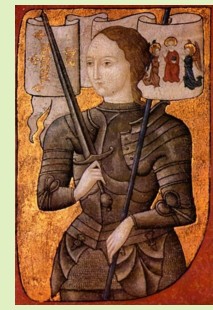
In the late 1330s, Edward III claimed the French throne, beginning the Hundred Years' War between England and France. His son (known as Edward the Black Prince because of the black ground on his coat of arms) led the English troops in many of the early campaigns of this war. In 1415, Henry V of England won the Battle of Agincourt, largely because of the skills of his Welsh and English longbowmen. In 1429, the tides of fortune turned to favor the French, largely due to the nationalistic fervor and more aggressive campaign tactics inspired by Joan of Arc. Joan of Arc was a French teenager who, believing herself to be guided by divine visions, took a leadership role in the French military efforts to recapture territory conquered by the English. Though she was captured and burned at the stake as a heretic in 1431, the English never regained their previous momentum in the war, and the French finally defeated them in 1453. For an article about Joan of Arc with a list of nonfiction books and novels about her, see Green World/Stone World: The Two Worlds of Joan of Arc.
E.C. Ambrose, Elisha Barber (2013), historical fantasy about a fourteenth-century barber-surgeon who discovers he has magical abilities; #1 in the Dark Apostle series. E.C. Ambrose, Elisha Magus (2014), historical fantasy about a barber-surgeon with magical abilities who has become a hunted man; #2 in the Dark Apostle series. Ann Benson, Thief of Souls (2002), about two strangely linked crime waves, one in modern Los Angeles, the other in medieval France involving Gilles de Rais.
Christian Cameron, The Long Sword (2014), about an English mercenary whose dreams of military glory in Europe are interrupted when he is sent on Crusade in 1364; #2 in the Chivalry series. Review Christian Cameron, The Green Count (2017), about an English mercenary charged with securing the support of a count in a mission to rescue the Roman Emperor of Constantinople; #3 in the Chivalry series. Christian Cameron, Sword of Justice (2018), about an English mercenary hoping he will choose the winning side in 1367 as Europe teeters on the brink of a war that promises to engulf every nation; #4 in the Chivalry series.
Bernard Cornwell, Vagabond (2002), about an English soldier during the Hundred Years War who returns to England following a hint that the Holy Grail may actually exist, and becomes involved in a war with the Scots; #2 in the Grail Quest series. Bernard Cornwell, Heretic (2003), about an English soldier during and after the fall of Calais in the Hundred Years War; #3 in the Grail Quest series. Bernard Cornwell, Azincourt (2008; titled Agincourt in the U.S.), about an archer in the army of King Henry V of England during the campaign that led to the victory at Agincourt (spelled Azincourt by the French); #4 in the Grail Quest series, but stands alone. Review Bernard Cornwell, 1356 (2012), about an English soldier who fights in the Battle of Poitiers on September 19, 1356, leading to an unlikely victory against heavy odds; #5 in the Grail Quest series, but stands alone. Review
Sir Arthur Conan Doyle, The White Company (1891), about a young man raised by monks who becomes the squire to an English knight on his way to fight in France in a company of archers. Sir Arthur Conan Doyle, Sir Nigel (1906), about English soldiers fighting in France during the Hundred Years War; a prequel to The White Company.
David Gilman, Defiant Unto Death (2015), about an English archer who survived the Battle of Crecy to become the leader of a war band and lord of a small French fiefdom; #2 in the Master of War series. David Gilman, Gate of the Dead (2016), about a mercenary soldier on his way back to England from Italy, who fears his summons, apparently from the queen, may be a trap set by his enemies; #3 in the Master of War series.
Michael Jecks, Fields of Glory Thomas Keneally, Blood Red, Sister Rose (1974), a literary novel about Joan of Arc from the time she began hearing voices until her capture by the Burgundians. Review Deryn Lake, The King's Women (2006), about Charles VII of France, the king helped to his throne by Joan of Arc. Robert Nye, The Life and Death of My Lord Gilles de Rais (1990), about the murderer of young boys who fought alongside Joan of Arc. Maureen Peters, Joan of the Lilies (1969), a short biographical novel about Joan of Arc. Lawrence Schoonover, The Burnished Blade Manda Scott, Into the Fire Julian Stockwin, The Powder of Death (2016), about an envoy recently returned from China and an Oxford scholar who vow that the secret of gunpowder must die with them, and the determination of King Edward III to use gunpowder to win in war. Mark Twain, Personal Recollections of Joan of Arc, by the Sieur Louis de Conte (1895; also published under the title Joan of Arc), a novel about Joan of Arc narrated by her page.
The Black Plague
From the mid-fourteenth century, on, Europe was stricken by a series of terrifying visitations from the Black Plague, which decimated the population. The epidemic began in the port cities carried, we now know, by rats harboring fleas whose bites spread the disease, which was later spread further by contact between infected people. Some, believing the plague to a punishment sent by God, adopted extreme penitent practices or began persecuting Jews. Others shed moral inhibitions and lived for the moment. The decline in population made workers scarce, so that serfs began to demand freedom and free workers better wages and working conditions.
Ann Benson, The Burning Road (1999), about the plague in medieval France and a medical researcher in a near future time of runaway genetic engineering; #2 in the Plague Tales series. Ann Benson, The Physician's Tale (2006), about a medical researcher in the near future and a medieval physician; #3 in the Plague Tales series. Christopher Buehlman, Between Two Fires (2012), a horror story about a disgraced Norman knight who in 1348 come upon the lone survivor of a plague-stricken town, a girl who tells him she has spoken with angels and persuades him to accompany her to Avignon. Rosie Garland, Vixen (2014), about a priest, his sixteen-year-old housekeeper, and a mute girl who turns up in the marshes, during a time of plague in fourteenth-century Devon. Linnea Heinrichs, The First Vial (2006), about a fourteenth-century noblewoman struggling to keep her castle and land during a plague epidemic. Karen Maitland, Company of Liars: A Novel of the Plague (2008), about a group of fourteenth-century travelers trying to escape the plague and the truth about themselves. Review Minette Walters, The Last Hours (2017), about a noblewoman who in June of 1348 when the Black Death ravages England, decides to quarantine her town and bring the serfs inside its walls for protection, provoking conflict with people unhappy about this overturning of the social order. Minette Walters, The Turn Of Midnight (2018), about a noblewoman, the mistress of a quarantined town in Dorset during the Black Death, and a free-thinking serf who leaves the town in search of food, news and freedom after the town's food stores run low; sequel to The Last Hours. Sylvia Townsend Warner, The Corner That Held Them (1948), about a community of Benedictine nuns in Norfolk during a fourteenth-century outbreak of the Black Plague. Connie Willis, Doomsday Book (1992), a novel about a woman of the future who time-travels to plague-stricken England in the fourteenth century.
The English Peasants' Rebellion
As the Hundred Years' War dragged on, English monarchs levied higher taxes on poor workers in order to finance it, creating hardships for workers whose lives were already difficult. With the population reduced by plague, workers came to realize their labor was in higher demand, and they began to protest the harsh and degrading conditions under which they lived. In June 1381, after Parliament passed a law requiring wages to be reduced to the old rates, Wat Tyler led a group of rebels in a march on London. Their success in negotiating concessions was only temporary.
Melvyn Bragg, Now is the Time Philip Lindsay, The Golden Cage Elizabeth Lord, Company of Rebels Karen Maitland, The Vanishing Witch (2014), about a wool merchant in Lincoln, his family, and the charming widow who insinuates herself into his life, during the time of the Peasant's Rebellion in 1381. Review at The Independent Philippa Wiat, The Hammer and the Sword Simone Zelitch, The Confession of Jack Straw Scotland
King Edward I of England pursued numerous military campaigns against both Wales and Scotland, both of which were essentially under English control by the end of the thirteenth century. The Scottish knight William Wallace led an unsuccessful uprising against England and was captured and executed as a traitor by the English in 1305. Robert the Bruce, crowned King of Scotland in 1306, continued to fight against England and finally won a decisive military victory at Bannockburn in 1314. Edward I's ambitious grandson Edward III renewed the wars against Scotland as well as pursuing a claim to the throne of France which began the Hundred Years' War.
Geoffrey Humphrys, The Wild Knight (2008), about King James IV of Scotland, who came to the throne at age sixteen, became an effective national leader, but died in the disastrous Battle of Flodden Field; not readily available. Julianne Lee, Knight Tenebrae, historical romance/fantasy about a modern British reporter and an American Navy pilot and his wife stranded together in the fourteenth-century Scotland of Robert the Bruce, while an inhuman enemy schemes to destroy them and all mankind; #1 in the Tenebrae series. Julianne Lee, Knight's Blood, historical romance/fantasy about a modern Navy pilot and his wife stranded in fourteenth-century Scotland, whose child has been kidnapped by the elfin king; #2 in the Tenebrae series. Julianne Lee, Knight's Lady, historical romance/fantasy about a modern Navy pilot and his wife stranded in fourteenth-century Scotland, and separated when the wife is taken to the faerie country; #3 in the Tenebrae series. Robert Low, The Lion Wakes (2011), about a nobleman whose family assigns him, as a political strategy, to join the rebellion of Robert the Bruce and William Wallace against England; #1 in the Kingdom series. Review Robert Low, The Lion at Bay (2012), about William Wallace as he returns to Scotland after fleeing to France after his failed rebellion, and Robert the Bruce as he defers his goal of becoming king because of rivalry among the clans; #2 in the Kingdom series. Allan Massie, The Hanging Tree (1990), about a fifteenth-century Scottish border family. Elisabeth McNeill, Flodden Field (2008), about James IV of Scotland and the Battle of Flodden Field. Jane Oliver, The Lion is Come (1951), about the Scottish king Robert the Bruce. N. Gemini Sasson, The Crown in the Heather N. Gemini Sasson, Worth Dying For Reay Tannahill, The World, the Flesh and the Devil (1985), set in fifteenth-century Scotland during the reign of King James I of Scotland.
Nigel Tranter, The Islesman (2002), about Angus Og MacDonald, Prince of the Hebrides and much of the West Highlands of Scotland in the early fourteenth-century, the time of Robert the Bruce. Nigel Tranter, The Steps to the Empty Throne (1969), about Robert the Bruce, who became King of the Scots in 1306; #1 in the Bruce trilogy. Nigel Tranter, The Path of the Hero King (1970), about Robert the Bruce, who became King of the Scots in 1306; #2 in the Bruce trilogy. Nigel Tranter, The Price of the King's Peace (1971), about Robert the Bruce, who became King of the Scots in 1306; #3 in the Bruce trilogy. Nigel Tranter, Flowers of Chivalry Nigel Tranter, Courting Favour (2000), about John of Moray, who served as a diplomat for King David of Scots in the fourteenth century and negotiated a peace treaty with England's John of Gaunt. Nigel Tranter, Lords of Misrule Nigel Tranter, A Folly of Princes (1977), about the turbulent rise of the Stewart family, who were descended from the daughter of Robert the Bruce; #2 in the Stewart trilogy. Nigel Tranter, The Captive Crown (1977), about the turbulent rise of the Stewart family, who were descended from the daughter of Robert the Bruce; #3 in the Stewart trilogy. Nigel Tranter, The End of the Line (2000), about the unlikely fifteenth-century friendship between the Scottish Earl of Dunbar and King Henry IV of England. Nigel Tranter, Lion Let Loose Nigel Tranter, The Lion's Whelp Nigel Tranter, Black Douglas
Laura Vosika, Blue Bells of Scotland
Jack Whyte, Robert the Bruce Jack Whyte, Uprising
Robyn Young, Renegade (2012), about the struggle of Robert the Bruce to claim the throne of Scotland; #2 in the Insurrection trilogy. Robyn Young, Kingdom (2014), about the struggle of Robert the Bruce, crowned king of Scotland, to defend his rule from Edward II of England; #3 in the Insurrection trilogy.
The Continent and Mediterranean, 14th-15th Centuries
This section includes novels set in France, Germany, Flanders and the Low Countries, Italy, Spain, Hungary and Eastern Europe, and even a fictional island in the Mediterranean Sea. Jump to Mysteries Click on the title for more information from Powell's Books or another online source, or if you're outside the U.S., try The Book Depository.
Radwa Ashour, Granada (1994-1995 in the original Arabic as a trilogy; English translation 2003), about a Muslim bookbinder and his family in Granada after 1492 and the end of Arabic rule in Moorish Spain. Honoré de Balzac, The Exiles (1831), about a man living near the cathedral Notre-Dame de Paris in the early fourteenth century who takes in two frightening guests who appear to him to be practicing sorcery. Lisa T. Bergren, The Begotten (2006), a fantasy thriller set in 1339 Italy about a lost letter of St. Paul and a group of Christians with unusual spiritual gifts who come together, according to the prediction in the letter, to fight Satan's power during the Inquisition; #1 in the Gifted trilogy. Lisa T. Bergren, The Betrayed (2007), a fantasy thriller set in fourteenth-century Italy about a lost letter of St. Paul and a group of Christians with unusual spiritual gifts who come together, according to the prediction in the letter, to fight Satan's power during the Inquisition; #2 in the Gifted trilogy. Lisa T. Bergren, The Blessed (2008), a fantasy thriller set in fourteenth-century Italy about a lost letter of St. Paul and a group of Christians with unusual spiritual gifts who come together, according to the prediction in the letter, to fight Satan's power during the Inquisition; #3 in the Gifted trilogy. David Blixt, The Master of Verona (2007), about Dante’s 17-year-old son and the Italian city of Verona in 1314, around the time of Romeo and Juliet. Review Rachel Caine, Prince of Shadows (2014), a retelling of the Romeo and Juliet story. Tracy Chevalier, The Lady and the Unicorn (2004), a novel set in medieval France that imagines how the fifteenth-century "Lady and the Unicorn" tapestries were created. Alix Christie, Gutenberg's Apprentice (2014), about Peter Schoeffer, who worked with Johann Gutenberg, the developer of the printing press. Review Hendrik Conscience, The Lion of Flanders (1838), a romantic nineteenth-century novel about Robert of Bethune, who ruled Flanders during the early fourteenth century and later became a symbol of Flemish nationalism. Thomas B. Costain, The Moneyman (1947), set in fifteenth-century France. John D. Cressler, Emeralds of the Alhambra (2013), about a Christian knight and a female Sufi mystic in fourteenth-century Granada. Michael Crichton, Timeline (1999), about a group of historians who travel back in time to the year 1357 in France. Matt Cutugno, In Dracula's Time Andrew Davidson, The Gargoyle (2008), about a modern man severely injured in a car wreck who is visited in the hospital by a mysterious woman claiming to have healed him before when she was a nun in fourteenth-century Germany. Review
Maurice Druon, The Strangled Queen (1955), about a French nobleman in the time of King Louis X, and his schemes to reclaim the inheritance he believes his aunt cheated him of; #2 in the Accursed Kings series. Maurice Druon, The Poisoned Crown (1957), about the last months of the reign of King Louis X; #3 in the Accursed Kings series. Maurice Druon, The Royal Succession (1957 in the original French; first English translation 1958), about the struggle for the succession after the death of King Louis X; #4 in the Accursed Kings series. Maurice Druon, The She-Wolf Maurice Druon, The Lily and the Lion Maurice Druon, The King Without a Kingdom (1977; also titled When a King Loses France), about the early years of the Hundred Years' War, which were disastrous for France; #7 and final in the Accursed Kings series.
Lina Ellina, The Venetian (2012), about a present-day Venetian searching for his ancestor on Cyprus, and about his ancestor's love affair with a low-born woman in 1467. Review Ildefonso Falcones, Cathedral of the Sea (English translation 2008), about a Spanish serf and the rise in his fortunes during the building of the Church of Santa Maria in fourteenth-century Barcelona. Lion Feuchtwanger, The Ugly Duchess Anne Fortier, Juliet (2010), about two young women, one a modern American, the other her mysterious possible ancestor in fourteenth-century Italy who inspired Shakespeare's Romeo and Juliet. Stephen Gaspar, The Templar and the True Cross
Jon Courtenay Grimwood, The Outcast Blade (2012), historical fantasy set in an alternative fifteenth-century Venice ruled by Marco Polo's descendants who employ vampire assassins; #2 in the Assassini trilogy. Jon Courtenay Grimwood, The Exiled Blade (2013), historical fantasy set in an alternative fifteenth-century Venice ruled by Marco Polo's descendants who employ vampire assassins; #3 in the Assassini trilogy.
Titania Hardie, The House of the Wind (2012), about a present-day San Francisco woman who stays at a villa in Tuscany, and about the shy young woman who lived in the same villa in the fourteenth century. Hermann Hesse, Narcissus and Goldmund (1930), a literary novel about a novice monk and an artist who become friends in medieval Germany. Joanna Hickson, The Agincourt Bride (2014), about the early life of the French princess Catherine de Valois, who would marry Henry V of England after he defeats the French at Agincourt. Cecelia Holland, Rakossy Cecelia Holland, The Lords of Vaumartin (1988), about an orphaned nobleman in fourteenth-century Paris. Review C.C. Humphreys, Vlad: The Last Confession (2009), about a small group of men summoned with messages and fragments of the sword of Vlad Dracula, with the prospect of reforming his Order of the Dragon; historical fantasy based on the story of the historical Count Vlad of Wallachia. Jane Johnson, Court of Lions (2018), about a woman of the present day and a fifteenth-century servant boy to Prince Abu Abdullah Mohammed of the Moorish kingdom of Granada. Review Jeanne Kalogridis, The Burning Times (2001), about a clairvoyant midwife caught up in the Inquisition in fourteenth-century France. Mitchell Kaplan, By Fire, By Water (2010), about Luis de Santángel, a Jewish convert to Christianity who served as finance minister to Spain's King Ferdinand and Queen Isabella as the power of the Inquisition grew. Review Stephen Leigh, Immortal Muse (2014), historical fantasy about a French alchemist and his wife who in 1352 drink an elixir that makes them immortal, after which they part, travel the world and meet such historical artists as Bernini, Vivaldi, William Blake and Gustav Klimt, before ending up together again in present-day New York. Lois Leveen, Juliet's Nurse (2014), about the nurse in Shakespeare's Romeo and Juliet. Review Geraldine McCaughrean, Vainglory Joyce Elson Moore, Jeanne of Clairmonde (2009), historical romance about a French heiress forced to depend on the squire sent by the king to evict her from her estate at the beginning of the Hundred Years War. Mary Novik, Muse (2013), about a woman who was scribe and lover of the fourteenth-century poet Petrarch. Review Irene Reti, Kabbalah of Stone (2009), about the spirit of an Old Testament prophetess and a young man from a converso family in 1491 Spain, on the eve of the expulsion of the Jews. Review Jean-Christophe Rufin, The Dream Maker (2013), about the fifteenth-century French merchant and financier Jacques Coeur. Rafael Sabatini, Bellarion the Fortunate Alan Savage, Queen of the Night Lawrence Schoonover, The Spider King (1954), about the late medieval French king Louis XI, who was born during the Hundred Years War when his father Charles was still the uncrowned Dauphin. Henryk Sienkiewicz, The Knights of the Cross (1900; also titled The Teutonic Knights), a tragic story about a young Polish knight, his lady-love and the Battle of Grunwald (or Tannenberg) in 1410, in which the Poles and Lithuanians defeated the Teutonic Knights. Barry Unsworth, Stone Virgin (1985), a literary novel set in Venice during the eighteenth and fourteenth centuries. Peter Vansittart, The Tournament Peter Vansittart, A Safe Conduct Jill Paton Walsh, Knowledge of Angels (1994), about a young woman raised by wolves, a prince who is an atheist and an agent of the Inquisition who meet on a fictional Mediterranean island. Florian Stone Wells, The Sword and the Shield of the Realm (2008), about a boy who inherits a mysterious legacy as fifteenth-century Hungary is threatened with invasion by the Ottoman Turks; includes a comprehensive glossary; #1 in a planned 7-book series. Florian Stone Wells, Field of the Blackbirds (2008), about about the 1389 Battle of Kosovo; #2 in a planned 7-book series. Jess Wells, The Mandrake Broom (2007), about a woman herbalist who works with Paracelsus to save the old medical knowledge and blend it with the new medical learning as the witch persecutions of the late fifteenth and early sixteenth centuries endanger herbalists.
Mysteries Set in the Continent, 14th-15th CenturiesClick on the title for more information from Powell's Books or another online source, or if you're outside the U.S., try The Book Depository.
Cassandra Clark, The Red Velvet Turnshoe (2009), about an English abbess who travels to Italy on a mission to find a holy relic and along the way must investigate the murder of a clerk whose body is found in a shipment of wool; #2 in the Abbess of Meaux mystery series. Cassandra Clark, The Law of Angels (2011), about an abbess who discovers that a young woman who has taken shelter as a guest in her community is being stalked by men who murdered her family; #3 in the Abbess of Meaux mystery series. Cassandra Clark, A Parliament of Spies (2012), about an abbess whose archbishop brings her to London with him to serve as his spy at a parliament during King Richard II's reign; #4 in the Abbess of Meaux mystery series. Cassandra Clark, The Dragon of Handale (2015), about a former abbess considering rejoining the Cistercian Order who travels to a priory on retreat, where she sees the mauled body of a man in the morgue and is told he was killed by a dragon; #5 in the Abbess of Meaux mystery series.
Ann Dukthas, A Time for the Death of a King (1994), a time-traveling French Jesuit scholar investigates the murder of Lord Darnley, the second husband of Mary, Queen of Scots, in 1567 Edinburgh; #1 in the Nicholas Segalla mystery series; Ann Dukthas is a pen name of P.C. (Paul) Doherty. Umberto Eco, The Name of the Rose (Italian edition 1980, English translation 1983), a literary murder mystery set in a monastery in fourteenth-century Italy during the time of the Inquisition. David Hillier, Fire and Shadow Catherine Jinks, The Inquisitor Catherine Jinks, The Notary Catherine Jinks, The Secret Familiar (2006), a stand-alone mystery novel about a former inquisitor's spy in fourteenth-century France who must return to his old work to investigate what happened to another spy for the Inquisition; not readily available outside Australasia.
Giulio Leoni, The Kingdom of Light (2009), a mystery featuring Dante doing some sleuthing on the side as he writes The Divine Comedy, when a galley with a dead crew lands in Florence with a damaged mechanical object on board. Giulio Leoni, The Third Heaven Conspiracy Giulio Leoni, The Crusade of Darkness (2011), a mystery featuring Florentine poet and government official Dante Alighieri investigating a series of ritual murders after he is sent to Rome in 1301 to meet with the Pope; #4 in the Dante Alighieri mystery series.
Caroline Roe, Cure for a Charlatan Caroline Roe, Antidote for Avarice (1999), a blind Jewish physician who accompanies a bishop to a religious council turns sleuth to find out why so many messengers from the pope are dying; #3 in the Isaac of Girona series. Caroline Roe, Solace for a Sinner Caroline Roe, Potion for a Widow Caroline Roe, A Draught for a Dead Man (2002), a blind Jewish physician travels to Catalonia for a wedding and finds himself in the midst of a risky plot to hide an escaped Christian convict in a Jewish ghetto where it's illegal for him to reside; #6 in the Isaac of Girona series. Caroline Roe, A Poultice for a Healer (2003), a blind Jewish physician in medieval Spain investigates the poisoning death of a messenger who brings alarming news; #7 in the Isaac of Girona series. Caroline Roe, Consolation for an Exile (2004), a blind Jewish physician in medieval Spain investigates a perplexing case of poisoning; #8 in the Isaac of Girona series.
Top of Page
|
 (1960), about the deformed younger son of an English lord on the Welsh border in the years after Owen Glendower's rebellion.
 (2012), about a nobleman outlawed after he joins a rebellion against the Earl of Lancaster during the reign of Edward II; self-published.
 (1941), about King Richard II of England, who came to the throne in 1377 at the age of ten.
 (2002), a novel based on the author's theory that Edward III was not Edward II's son.
 (2006), a sympathetic novel about Queen Isabella, the wife of Edward II.
 (2012), about Catherine of Valois, the French princess who married King Henry V of England and later, through her secret marriage to Owen Tudor, founded the Tudor dynasty, narrated by her nursemaid.
 (2013), about a woman of the present who discovers an unusual history of England written by her dead grandfather, beginning with the invention of the printing press in 1436.
  (1992), a sympathetic novel narrated by Edward II about his love affair with Piers Gaveston.
 (1980), historical romance about a woman who falls in love with Roger Mortimer; sequel to A Love So Bold.
 (1977), about Edward II's daughter Joan, Queen of Scotland, and her efforts to understand the events of her father's reign.
 (1957), about Catherine of Valois, the French princess who married Henry V in 1420 after he defeated France.
 (1959), a family saga which begins with a serf born in 1381 who wins his freedom and builds a house in a town in Suffolk, England; #1 in the Suffolk Trilogy.
 (1961), a family saga about the descendants of a serf who won his freedom and built a house in Suffolk, England; #2 in the Suffolk Trilogy.
 (1962), a family saga about the descendants of a serf who won his freedom and built a house in Suffolk, England; #3 in the Suffolk Trilogy.
 (1972), about a girl in fifteenth-century England who would like to become a wool merchant like her father, but must learn to be a lady instead.
 (1975), about the wife of a knight who must cope with a plague epidemic, among other hardships, while her husband is away; #1 in the Sir Godfrey Tallboys trilogy.
 (1975), a family saga about the wife of a knight whose husband returns from the Crusades with the young woman who rescued him from slavery and is now pregnant with his child, and their children's generation; #2 in the Sir Godfrey Tallboys trilogy.
 (1976), about a knight's son in fifteenth-century England who has rejected the life of the aristocracy to become a simple farmer; #3 in the Sir Godfrey Tallboys trilogy - can be read as a stand-alone novel.
 (2011), about a servant girl falsely accused of murdering her child during the time when King John is excommunicate and England is under interdict.
 (2011), about an English orphan whose misadventures land him in a company of Catalonian crossbowmen on their way to fight in the 14th-century war between the supporters of the two claimants for the papacy.
 (1985), a novel narrated by Queen Isabella, the wife of Edward II.
 (1970; also titled
  ), about King Edward I of England; #7 in the Plantagenet series.
  (1981), about the Lancaster kings Henry IV and Henry V; #11 in the Plantagenet series.
 (2009), about two Welsh brothers, one a mute with skills that seem uncanny to the English, forced into service as ditch-diggers during the building of King Edward I's castle at Flint; #1 in the Flint series.
  (2015), about a girl from Turkey who goes in search of her Welsh grandfather after her grandmother dies and she is sent back to her father's tribe, where she is in danger; #2 in the Flint series.
 (2016), about a girl searching for her Welsh grandfather, while King Edgar of England persecutes the Welsh; #3 in the Flint series.
 (1972; titled
  in the U.K.), about King Henry V.
 (1991-1993), about the religious struggles of a fourteenth-century abbot in Yorkshire; an omnibus edition of three novels, The Hawk and the Dove, The Wounds of God and The Long Fall; Christian message.
 (1956), a novel about Robin Hood set during the reign of Edward II.
 (1986), about a clerk for King Edward I who solves mysteries; set in the late thirteenth century; #1 in the Hugh Corbett mystery series.
 (1993), about a woman physician who investigates a series of murders of pilgrims to Canterbury Cathedral in 1471, which seem related to Chaucer's unpublished series of tales; #1 in the Kathryn Swinbrooke series. C.L. Grace is a pen name for Paul Doherty.
 (1994), about a woman physician commissioned by King Edward IV to recover a valuable sapphire in the hands of Lancastrian rebels; #2 in the Kathryn Swinbrooke series. C.L. Grace is a pen name for Paul Doherty.
 (1995), about a woman physician charged with finding the murderer of a king's tax collector and recovering the stolen taxes; #3 in the Kathryn Swinbrooke series. C.L. Grace is a pen name for Paul Doherty.
 (1996), about a woman physician directed by the Queen to identify the murderer of a practitioner of the dark arts and recover his diary which contains secrets about the Queen; #4 in the Kathryn Swinbrooke series. C.L. Grace is a pen name for Paul Doherty.
 (2001), about a woman physician charged with investigating who killed a spy for the king and exposing a likely traitor on the king's council; #5 in the Kathryn Swinbrooke series. C.L. Grace is a pen name for Paul Doherty.
 (2002), about a woman physician investigating the murder of a prominent nobleman in Canterbury; #6 in the Kathryn Swinbrooke series. C.L. Grace is a pen name for Paul Doherty.
 (2004), about a woman physician visiting Walmer on state business who investigates the mysterious poisoning deaths of a blacksmith and his wife; #7 in the Kathryn Swinbrooke series. C.L. Grace is a pen name for Paul Doherty.
 (2011), a thriller about a Templar Knight from Ireland who is condemned as a heretic but offered a reprieve if he agrees to work as a spy for King Edward of England; self-published.
 (2007), about a medieval hitman tormented by his conscience after John of Gaunt sends him on a mission to kill the author of Gawain and the Green Knight, believed to contain seditious material against King Richard II; #1 in the Priedeux mystery series.
 (2013), about about a Scottish archbishop's questioner investigating the disappearance of a blackmailer, said to have been carried off by the Devil; #10 in the Gil Cunningham mystery series.
 (2010), about a young surgeon in Oxford in 1363 who must investigate a case of murder after human bones are discovered on a nobleman's estate; #3 in the Hugh de Singleton Surgeon Chronicles series.
 (2014), about the English troops who fought in the Battle of Crécy in 1346.
 (2015), about a present-day woman investigating a series of arson attacks in Orleans, and an Englishman sent to France during the Hundred Years' War with the mission of assassinating Joan of Arc.
 (2015), about Wat Tyler and the Peasants Revolt of 1381.
 (2005), about a fourteenth-century blacksmith who leads a group of villagers to London to protest the oppressive poll tax and, ultimately, to join the English Peasants' Rebellion.
 (2010), about the rivalry of Robert the Bruce and John Balliol for the throne of Scotland; #1 in the Bruce trilogy; self-published.
  (2011), about the rise of Robert the Bruce; #2 in the Bruce trilogy; self-published.
  (1976), about Jamie Douglas, the bastard son of a Scottish lord, and the turbulent rise of the Stewart family, who were descended from the daughter of Robert the Bruce; #1 in the Stewart trilogy.
  (2009), about a modern man and a man of the fourteenth century who find themselves switching times, with the modern man sent back to Scotland shortly before the Battle of Bannockburn as the medieval Scot is sent to the 21st century; #1 in a planned trilogy; self-published.
 (2012; also titled The Renegade), about Robert the Bruce, from his childhood to his struggle to defend Scotland's independence from King Edward Plantagenet of England; #2 in the Guardians/Braveheart trilogy.
 (2014; also titled
  (2011), about a fifteenth-century biography of Vlad the Impaler which became the inspiration for Bram Stoker's novel Dracula.
 ), about a French nobleman in the time of King Philippe IV (1285-1314) who believes his aunt has cheated him of his inheritance; #1 in the Accursed Kings series.
 (1960), about Queen Isabella of France and her love affair with the English nobleman Roger Mortimer during his exile in France; #5 in the Accursed Kings series.
 (1960), about King Edward III of England, King Philippe of France, and their competing claims to the throne of France, which led to the Hundred Years' War; #6 in the Accursed Kings series.
 (2012), about a former Templar knight who returns to France and is asked to investigate a possible plot against King Philip IV that involves the theft of a sacred relic; self-published.
 (1991), about an aristocratic French family's obsession with wealth and castle-building through five generations beginning in 1429.
  (1993), about Queen Joanna of Naples.
 (1959), about the rituals and ceremonies surrounding a challenge to combat between a nobleman and the ruler of a fictional duchy resembling late medieval Burgundy, interrupted by a plague epidemic.
 (1995), about a children's revolt in a small German principality in the 1490s and the nobleman whose life it complicates.
  (2011), a mystery featuring Florentine poet Dante Alighieri investigating the murder of a mosaic artist in a disused church; #3 in the Dante Alighieri mystery series.